Interstitial lung diseases associated with systemic autoimmune diseases (SAD-ILD) are a significant cause of morbidity and mortality. The approval of nintedanib for ILD with a progressive fibrosing phenotype (PFP) and progressive systemic sclerosis-associated interstitial lung disease (SSc-ILD), based on the INBUILD and SENSCIS clinical trials, has marked a shift in the therapeutic paradigm.1,2 However, evidence from real-world clinical practice remains limited to a few heterogeneous series of SAD-ILD.3–5
We present our clinical experience with nintedanib in a cohort of patients with SAD-ILD with PFP treated at our hospital. We conducted an observational, descriptive, and retrospective study, including all patients treated with nintedanib who had a diagnosis of ILD associated with a systemic autoimmune disease and who presented with PFP between October 2022 and March 2025. Patients receiving nintedanib for other indications (such as PFP or other ILDs not secondary to SAD with a progressive fibrosing pattern) were not included.
Demographic and clinical data, radiological characteristics, and concomitant treatments were collected. Clinical, functional, and radiological responses, as well as safety-related aspects were assessed.
To establish the diagnosis of PFP, the criteria set out in the most recent international guidelines6: the presence of fibrosis on high-resolution computed tomography (HRCT) and at least two of the following criteria in the past year, with no alternative explanation: 1) worsening of respiratory symptoms, 2) an absolute decrease in forced vital capacity (FVC) ≥ 5% or diffusing capacity for carbon monoxide (DLCO) ≥ 10%, and 3) radiological progression of fibrosis on HRCT.
Clinical response was assessed based on changes in the New York Heart Association (NYHA) functional class. Functional improvement was considered to have occurred when there was an increase of ≥5% in forced vital capacity compared with baseline; stability was noted if the change was <5%; and deterioration was noted if there was a decrease of ≥5%. Radiological progression was assessed through a radiologist specialising in interstitial lung disease visually comparing baseline and follow-up high-resolution computed tomography scans and analysing changes in the extent of pulmonary fibrosis, including reticulation, traction bronchiectasis, and honeycombing.
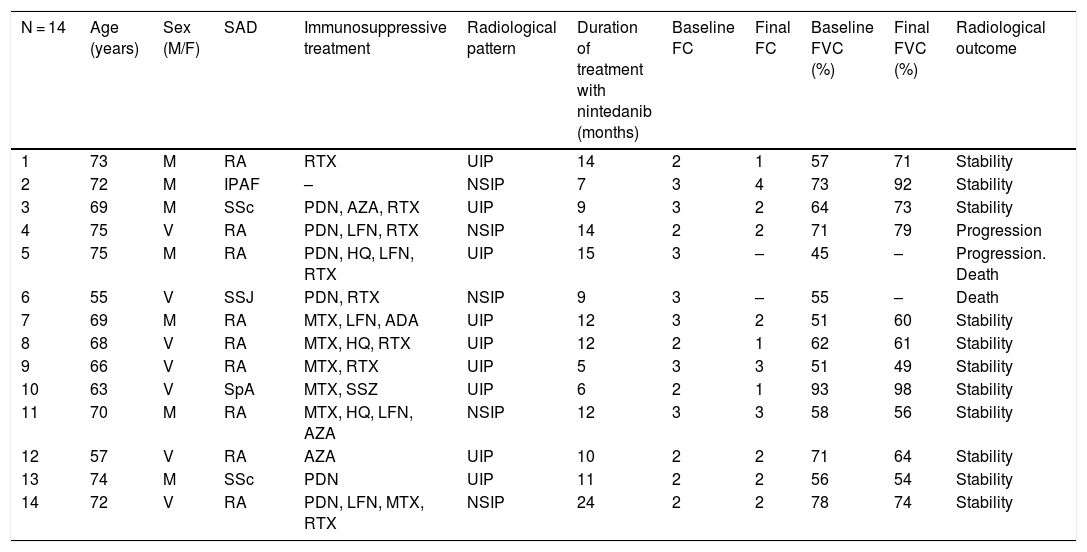
The study included 14 patients (50% women) with a mean age of 68.6 years. The diagnoses were rheumatoid arthritis (n = 9), Sjögren’s syndrome (n = 3), interstitial pneumonia with autoimmune features (n = 1), spondyloarthritis (n = 1), and systemic sclerosis (n = 2). The median time from diagnosis of SLE to the development of IPD was 6 years, and the median time from diagnosis of ILD to the start of nintedanib was 3.6 years (min. .5/max. 15). The mean duration of treatment was 12 months. The predominant radiological pattern was UIP (n = 9) compared with NSIP (n = 5) (Table 1). The most frequently used immunosuppressive treatment was rituximab (57%), followed by systemic glucocorticoids (43%), leflunomide (36%), and methotrexate (36%). Other immunosuppressants used less frequently were azathioprine (21%) and hydroxychloroquine (14%), and the patient with spondyloarthritis had received adalimumab.
Clinical, radiological, and functional characteristics of patients with ILD associated with systemic autoimmune diseases treated with nintedanib.
| N = 14 | Age (years) | Sex (M/F) | SAD | Immunosuppressive treatment | Radiological pattern | Duration of treatment with nintedanib (months) | Baseline FC | Final FC | Baseline FVC (%) | Final FVC (%) | Radiological outcome |
|---|---|---|---|---|---|---|---|---|---|---|---|
| 1 | 73 | M | RA | RTX | UIP | 14 | 2 | 1 | 57 | 71 | Stability |
| 2 | 72 | M | IPAF | – | NSIP | 7 | 3 | 4 | 73 | 92 | Stability |
| 3 | 69 | M | SSc | PDN, AZA, RTX | UIP | 9 | 3 | 2 | 64 | 73 | Stability |
| 4 | 75 | V | RA | PDN, LFN, RTX | NSIP | 14 | 2 | 2 | 71 | 79 | Progression |
| 5 | 75 | M | RA | PDN, HQ, LFN, RTX | UIP | 15 | 3 | – | 45 | – | Progression. Death |
| 6 | 55 | V | SSJ | PDN, RTX | NSIP | 9 | 3 | – | 55 | – | Death |
| 7 | 69 | M | RA | MTX, LFN, ADA | UIP | 12 | 3 | 2 | 51 | 60 | Stability |
| 8 | 68 | V | RA | MTX, HQ, RTX | UIP | 12 | 2 | 1 | 62 | 61 | Stability |
| 9 | 66 | V | RA | MTX, RTX | UIP | 5 | 3 | 3 | 51 | 49 | Stability |
| 10 | 63 | V | SpA | MTX, SSZ | UIP | 6 | 2 | 1 | 93 | 98 | Stability |
| 11 | 70 | M | RA | MTX, HQ, LFN, AZA | NSIP | 12 | 3 | 3 | 58 | 56 | Stability |
| 12 | 57 | V | RA | AZA | UIP | 10 | 2 | 2 | 71 | 64 | Stability |
| 13 | 74 | M | SSc | PDN | UIP | 11 | 2 | 2 | 56 | 54 | Stability |
| 14 | 72 | V | RA | PDN, LFN, MTX, RTX | NSIP | 24 | 2 | 2 | 78 | 74 | Stability |
ADA: adalimumab; AZA: azathioprine; F: female; FC: functional class (NYHA); FVC: forced vital capacity; HQ: hydroxychloroquine; IPAF: interstitial pneumonia with autoimmune features; LFN: leflunomide; M: male; MTX: methotrexate; NSIP: non-specific interstitial pneumonia; PDN: prednisone; RA: rheumatoid arthritis; RTX: rituximab; SpA: spondyloarthritis; SSJ: Sjögren’s syndrome; SSZ: sulphalazine; SSc: systemic sclerosis; UIP: usual interstitial pneumonia.
Clinical and functional follow-up was performed in the 12 patients who completed the study observation period. Improvement or stability in NYHA functional class was observed in 5 and 6 patients, respectively. There was an increase in mean forced vital capacity from 63.00% ± 13.17% to 64.23% ± 23.10%, which did not reach statistical significance; improvement was observed in 6 patients, and stability in 3. Radiological stability was observed in 11 patients and progression in 2; in one case, the radiological assessment could not be completed due to death during follow-up, without a follow-up HRCT scan.
In terms of safety, the most common adverse effects were gastrointestinal in nature and ranged from mild to moderate in severity. These effects consisted of nausea, diarrhoea, loss of appetite, vomiting, and weight loss. These events required dose adjustments for several patients: 4 had their dose temporarily reduced, and 2 subsequently had the full dose reintroduced following improvement in symptoms.
Treatment was discontinued in 3 patients due to significant gastrointestinal intolerance. The transient elevation in liver enzymes observed in one case resolved following the initial dose reduction, and the full dose could subsequently be resumed.
Four patients required hospitalisation, although these complications were not considered directly related to nintedanib: 3 due to respiratory infection (2 associated with exacerbation of ILD, with a fatal outcome in one of them), and one due to activity of their autoimmune disease, resulting in death from abdominal sepsis. The hospitalisation rate was higher than that reported in the trials, likely due our patients’ older age, comorbidity, and baseline severity, which limits direct comparison with more selected populations.
Furthermore, discontinuation due to adverse effects in our cohort (3 out of 14 patients) was comparable to or even lower than that described in the pivotal studies, where discontinuation reached 19% in INBUILD and 16% in SENSCIS. This suggests that the dose-reduction strategies and individualised titration employed in real-world clinical practice may promote better tolerability, even in older patients with greater comorbidity.
Our findings suggest that the use of nintedanib in combination with immunosuppressants is effective and safe in SAD-ILD in real-world practice, showing primarily clinical, functional, and radiological stabilisation even though the patients were older and had poorer baseline functional status than those in clinical trials. This effect was observed even though the patients were older, had a longer duration of lung disease, and a worse baseline functional status than those in trials such as INBUILD or SENSCIS, in which exposure to immunosuppressants was also more limited. These results are consistent with those of other Spanish and European series on RA-ILD and SAD-ILD,3–9 which include similar populations of older patients with more advanced disease progression.
Despite its limitations, our study provides real-world evidence on the management of these patients in real-life settings. In this context, the combined use of nintedanib with immunosuppressants, which is common in clinical practice but less frequently observed in clinical trials, may contribute to the functional stability observed. However, it is not possible to establish the relative contribution of each treatment. Furthermore, the fact that many patients start nintedanib at later stages of the disease, after years without access to antifibrotic therapy, could influence the results and suggests that earlier initiation might be beneficial - an aspect that requires confirmation.
In conclusion, nintedanib appears to be an effective therapeutic alternative with an acceptable safety profile for patients with SAD-ILD and PFP, including in populations more complex than those in clinical trials. Our findings support its use in real-world clinical practice and suggest benefits in terms of functional and clinical stability. However, multicentre, prospective studies are required to confirm these results, determine the optimal timing for initiating treatment, and better clarify the role of combination strategies.