

Women constitute the majority in Argentine rheumatology research, but their participation in rheumatology guidelines and recommendations (RGRs) has not been evaluated.
ObjectiveTo analyze women's representation in RGRs published between 2010 and 2024 that included at least one Argentine rheumatologist.
MethodsCross-sectional bibliometric study of rheumatology guidelines and recommendations published between January 1, 2010, and December 31, 2024, including at least one rheumatologist affiliated with an Argentine center. Publications were identified through searches in PubMed, the Revista Argentina de Reumatología, and Google Scholar using predefined affiliation-based keywords. The main study variables were author gender, first and corresponding authorship, guideline classification national (NAC) or international (INT), and declared conflicts of interest with the pharmaceutical industry. Descriptive analyses were performed, and group comparisons were conducted using the Mann–Whitney U test and chi-square test.
ResultsEighty-seven RGRs were analyzed (79% INT), with a median publication year of 2021. Of 526 authors, 274 (52%) were women. In NAC RGRs, 57% of authors were women versus 43% in INT (p=0.003). Among 25 first authors based in Argentina, 11 (44%) were women; among 12 corresponding authors, 5 (42%) were women. COIs were reported in 24 RGRs, totaling 59 declarations, 37 (63%) from men.
ConclusionsAlthough women are the majority among Argentine rheumatology researchers, their representation decreases in international publications and leadership roles. Conflicts of interest show a gender bias favoring men.
Las mujeres son mayoría en la investigación reumatológica argentina, pero no se ha evaluado su participación en las guías y recomendaciones en reumatología (GRR).
ObjetivoAnalizar la representación femenina en las GRR publicadas entre 2010 y 2024 que incluyeran al menos un/a reumatólogo/a con afiliación en Argentina (ARG).
MétodosEstudio bibliométrico transversal de GRR en reumatología publicadas entre el 1 de enero de 2010 y el 31 de diciembre de 2024 que incluyeron al menos un/a reumatólogo/a ARG. Las publicaciones fueron identificadas mediante búsqueda en PubMed, Revista Argentina de Reumatología y Google Scholar utilizando combinaciones predefinidas en el campo de afiliación. Se registraron el género de los autores, la autoría principal y de correspondencia, la clasificación de la guía como nacional (NAC) o internacional (INT), y los conflictos de interés (COI) declarados. Se realizaron análisis descriptivos y comparativos (Mann–Whitney U y chi-cuadrado).
ResultadosSe analizaron 87 GRR (79% INT), con mediana de publicación en 2021. De 526 autores, 274 (52%) fueron mujeres. En las GRR NAC, el 57% de los autores fueron mujeres vs 43% en las INT (p=0,003). Entre los primeros autores ARG, el 44% fueron mujeres; entre los autores de correspondencia, el 42%. Se declararon COI en 24 GRR (59 declaraciones), 63% correspondientes a hombres.
ConclusionesLa participación femenina es mayoritaria en las GRR NAC, menor en las INT y en los roles de liderazgo. Los COI muestran un sesgo de género favorable a los hombres.
As in many other countries,1,2 the rheumatology workforce in Argentina has undergone a process of feminization. According to a study presented in 2025, women represent 61% of the national rheumatology workforce.3 This trend is expected to continue in the coming years, as over 70% of new enrollees in the Rheumatology Specialist Program at the University of Buenos Aires – the largest in the country – are women.4
A similar pattern is observed in rheumatology research. A 2025 study showed that women accounted for 62% of authors in the Revista Argentina de Reumatología, although their participation decreased to 55% in PubMed-indexed publications and to 44% as corresponding authors. However, more than 70% of declared relationships with the pharmaceutical industry were held by men.5
Gender equality extends beyond achieving numerical parity in the workforce; it also involves equitable participation in leadership and decision-making roles. Clinical practice guidelines and consensus statements developed by scientific societies guide medical practice and serve as key references for healthcare professionals. Diversity within the panels that develop these documents enhances the relevance and fairness of recommendations by incorporating varied perspectives and contexts. In particular, women's participation has been associated with greater gender sensitivity in clinical guidelines and healthcare settings.6
Conflicts of interest are widely recognized within rheumatology as a relevant ethical issue. In a study by Putman et al., male rheumatologists were reported to receive substantially higher industry payments than female rheumatologists. Although the impact of financial relationships with the pharmaceutical industry on clinical practice is difficult to quantify, they have been associated with prescribing behaviors.7
Therefore, we conducted this study to analyze women's representation in rheumatology guidelines and recommendations (RGRs) published between 2010 and 2024 that included at least one Argentine rheumatologist.
MethodsStudy design and data sourcesA bibliometric analysis of rheumatology guidelines and recommendations (RGRs) was conducted. Articles corresponding to RGRs or consensus statements published between January 1, 2010, and December 31, 2024, that included at least one rheumatologist affiliated with an Argentine center were selected. When all participating institutions were based in Argentina, the RGR was classified as national (NAC). When at least one participating center was located outside Argentina, it was classified as international (INT).
The initial search strategy included four keyword combinations applied to the “Affiliation” field: (“Rheumatology” OR “Reumatología”) AND (“Argentina” OR “Argentine”) in the PubMed database. In addition, all rheumatology articles published in the Revista Argentina de Reumatología (RAR) during the same period were reviewed. A complementary search was also conducted in Google Scholar. In cases where the relevance of an article to the field of rheumatology was uncertain, inclusion was determined by majority consensus among the authors.
Data extractionFor authors affiliated with Argentine centers, gender (binary classification: woman/man) was recorded for each article. To distinguish between participation, responsibility, and leadership, the gender of the first and corresponding authors was identified. Conflicts of interest (COIs) with the pharmaceutical industry were analyzed based on authors’ declarations, recording both the number of disclosures and the gender of those making them. Gender was determined by the authors based on first names. As the study focused on authors of clinical practice guidelines and consensus documents – who are typically senior rheumatologists and widely known within the specialty – identification was generally straightforward. Automated gender prediction tools were not used. Authors were classified based on institutional affiliation; references to “Argentine” authors refer to authors affiliated with centers based in Argentina, regardless of nationality.
Only authors affiliated with centers based in Argentina were included in the analysis, both in national and international guidelines. Authors affiliated with institutions outside Argentina were not considered.
Statistical analysisA descriptive analysis of all included variables was performed. Continuous variables were summarized using the median and interquartile range (IQR, 25th–75th percentiles), while categorical variables were expressed as absolute frequencies and percentages. For group comparisons, numerical variables were analyzed using the Mann–Whitney U test, and categorical variables using the chi-square test. Statistical significance was defined as a two-tailed p-value <0.05. Analyses were performed using Epi Info software, version 3.5.4.
Ethical considerationsAs the data analyzed were publicly available, informed consent was not required, nor was authorization from the institutional ethics committee requested.
Declaration of AI assistanceDuring the translation of this work into English, the authors used ChatGPT (GPT-5, OpenAI) to improve clarity and readability. The authors subsequently reviewed and adjusted the content as necessary and take full responsibility for the final version of the manuscript.
ResultsA total of 99 RGRs were identified. After excluding 3 duplicates and 9 that were not related to the field of rheumatology, 87 RGRs were finally included in the study. Among these, 73 were indexed in PubMed, 13 were published in the Revista Argentina de Reumatología, and one consensus statement was found on the website of the Argentine Society of Rheumatology.
Of the 87 included RGRs, 69 (79%) were international and 18 (21%) were national. The median year of publication was 2021. In total, 526 authors were identified, of whom 274 (52%) were women.
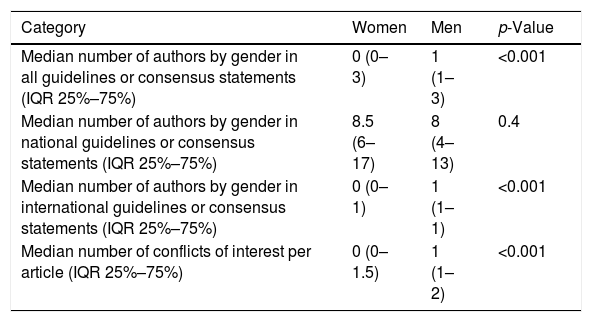
In the 18 national RGRs, 334 authors were identified, of whom 191 (57%) were women. Conversely, in the 69 international RGRs, 192 authors were identified, of whom only 83 (43%) were women (p=0.003). The median number of authors per RGR, by gender and classification (NAC or INT), is shown in Table 1.
Median number of authors and conflicts of interest by gender in guidelines or consensus statements.
| Category | Women | Men | p-Value |
|---|---|---|---|
| Median number of authors by gender in all guidelines or consensus statements (IQR 25%–75%) | 0 (0–3) | 1 (1–3) | <0.001 |
| Median number of authors by gender in national guidelines or consensus statements (IQR 25%–75%) | 8.5 (6–17) | 8 (4–13) | 0.4 |
| Median number of authors by gender in international guidelines or consensus statements (IQR 25%–75%) | 0 (0–1) | 1 (1–1) | <0.001 |
| Median number of conflicts of interest per article (IQR 25%–75%) | 0 (0–1.5) | 1 (1–2) | <0.001 |
IQR: interquartile range.
In 25 RGRs, the first author was based in Argentina; in 11 (44%) of these cases, the first author was a woman. In 12 RGRs, the corresponding author was based in Argentina; in 5 (42%) of these, the corresponding author was a woman.
Conflicts of interest (COIs) with the pharmaceutical industry were declared in 24 RGRs. In 16 (67%) of these, COIs were declared exclusively by men, and in the remainder by both men and women. A total of 59 COIs were reported, of which 37 (63%) corresponded to men and the rest to women. The median number of COIs by gender is presented in Table 1.
DiscussionIn our study, relevant differences emerged when the variables were analyzed jointly. Women represented 52% of all authors; however, they were more highly represented in national guidelines than in international ones, and their participation decreased in leadership roles such as first and corresponding authorship. Conflicts of interest with the pharmaceutical industry were more frequently declared by men. Taken together, these findings indicate that although women constitute the majority of the rheumatology workforce in Argentina, disparities persist in contexts associated with greater academic visibility, international collaboration, leadership roles, and external professional engagement.
The situation in other specialties is generally less favorable than that observed here. The proportion of women authors in guidelines or consensus statements has been reported as 20% in Hepatology,8 22% in Cardiology,9 24% in Anesthesiology,10 and 27.4% in Otolaryngology.11 In Endocrinology, only 28.9% of first authors were women.12
In 2018, Merman et al. analyzed all clinical practice guidelines published in the United States between 2012 and 2017 in the National Guideline Clearinghouse and Guideline Central, focusing on documents aimed at physicians. They found that only in Obstetrics and Gynecology and in Neurosurgery did the median proportion of women authors reach 50%, while in Rheumatology – based on four analyzed guidelines – female participation was 37.6%.13 Similarly, Adami et al. evaluated 366 international RGRs published between 2004 and 2019 and observed that, although women's participation increased over time, only 32% were first authors.14 Although the situation of Argentine women rheumatologists appears somewhat more favorable, it is noteworthy that while our analysis covers a similar time span to that of Adami et al., in our case half of the RGRs were published within the last four years, whereas in Adami's work publications were more evenly distributed over the 15-year period. Temporal trends in women's participation were not formally analyzed.
Finally, Lauper et al. examined trends and factors associated with female authorship in randomized controlled trials in rheumatology, finding that a woman was more likely to be the first author when another woman occupied the last author position. According to the authors, this last position typically corresponds to a senior or more experienced rheumatologist. In our study, the analysis focused on corresponding authors; however, as only five RGRs had an Argentine woman as corresponding author, a comparable analysis could not be performed.15
This study has some limitations. A key limitation is the absence of a centralized public database in Argentina comparable to the Centers for Medicare and Medicaid Services Open Payments system used in previous research by Putman et al.7 Consequently, the analysis relied on conflicts of interest voluntarily disclosed by the authors of the included guidelines and recommendations, which may underestimate the extent of relationships with the pharmaceutical industry. In that study, it was shown that male rheumatologists receive substantially higher industry payments than female rheumatologists.
In addition, in our previous bibliometric study of Argentine rheumatology research, although women constituted the majority of authors overall, only 28.1% of authors in industry-sponsored studies were women. Moreover, among publications declaring COIs, 71.0% listed exclusively male disclosures.5 Given that approximately 61% of the Argentine rheumatology workforce is composed of women,3 the finding that most COI disclosures in the present study corresponded to men reflects a consistent gender imbalance across different types of scientific production. Although conflicts of interest do not constitute leadership roles per se, disparities in industry engagement may represent another dimension of gender distribution within professional recognition and external visibility. However, industry relationships should not be interpreted as formal indicators of leadership or decision-making roles within guideline panels. Rather, their inclusion aims to describe gender distribution patterns in external professional engagements, without inferring direct influence on guideline development processes. Despite the growing participation of women in rheumatology, persistent structural barriers consistent with vertical segregation, or the “glass ceiling,” may limit their recognition and advancement to leadership and decision-making roles compared with men with similar qualifications.16 Although updated data on the proportion of women in the workforce are available, there is limited information regarding their representation in leadership positions, department head roles, key academic appointments, or the duration of their tenure in such positions. For example, in Spanish Rheumatology, Delgado Beltrán et al. recently reported that women are underrepresented in leadership roles.17 Although similar local data are lacking, only two of the last ten presidents of the Argentine Society of Rheumatology have been women. This imbalance may have influenced the lower female participation in international RGRs and their relationships with the pharmaceutical industry.
A key strength of this study is that gender representation was interpreted in relation to the actual composition of the Argentine rheumatology workforce, rather than against an arbitrary 50/50 benchmark. Given that women represent more than 60% of practicing rheumatologists in Argentina, equal numerical representation in authorship or leadership roles would still indicate relative underrepresentation. By using the workforce distribution as the reference framework, our analysis provides a more context-sensitive assessment of gender equity in guideline authorship and leadership.
ConclusionsOverall, Argentine women constitute the majority among authors of RGRs; however, their representation decreases in international documents. Their participation is also lower as first and corresponding authors, and conflicts of interest with the pharmaceutical industry reveal a gender bias favoring men. These findings highlight the need to promote equitable representation of women in leadership and authorship roles within rheumatology guideline development.
Authors’ contributionsConceptualization and methodology: BN, GS, EMK. Investigation: BN, GS. Funding acquisition: N/A. Data curation, validation, project administration, and supervision: BN, GS, EMK. Resources: GS, EMK. Formal analysis: BN, GS. Writing – original draft preparation: BN, GS, EMK. Writing – review and editing: all authors contributed to the manuscript, approved the final version, and agreed to be accountable for all aspects of the work.
Compliance with ethical standardsAs the data analyzed are publicly available, informed consent was not required, nor was authorization from the institutional ethics committee requested.
FundingThis research received no specific grant from any funding agency in the public, commercial, or not-for-profit sectors.
Conflict of interestThe authors declare that they have no conflicts of interest.
Data availabilityData will be shared upon reasonable request.
This study was presented in part as a poster at the 58th Argentine Congress of Rheumatology, held in Tucumán, Argentina, from October 8 to 11, 2025.