
Breastfeeding in systemic lupus erythematosus (SLE) is often influenced by concerns about medication safety, with limited data on patients’ perceptions and decision-making.
ObjectivesTo assess breastfeeding knowledge, intentions, and practices among women with SLE, focusing on disease activity and medication-related perceptions, particularly regarding hydroxychloroquine and prednisone.
MethodsA cross-sectional survey was conducted with women diagnosed with SLE. Participants answered questions on demographics, previous pregnancy and breastfeeding experiences, knowledge of breastfeeding with SLE, and perceptions of breastfeeding safety with hydroxychloroquine and prednisone. The survey also assessed their intention to breastfeed in future pregnancies, especially during active disease.
ResultsThe survey was completed by 85 patients, with a mean age of 35 years (SD 9). Of these, 56% reported at least one pregnancy, 53% had breastfed, and 32.9% had a child after being diagnosed with SLE (SLE&Child group). When considering future pregnancies, 88% intended to breastfeed, but 62% prioritized treatment over breastfeeding if SLE was active (p<0.001). After reading patient information leaflets (PILs), 64% considered breastfeeding on prednisone, while only 26% thought it safe with hydroxychloroquine. Breastfeeding knowledge was higher in the SLE&Child group. Initiation rates were 79.3% in the SLE&Child group and 93.2% in controls (p=0.08). The average breastfeeding duration was 14 months in the SLE&Child group and 17 months in controls (log-rank test=0.5).
ConclusionsMost patients with SLE intended to breastfeed, but this intention decreased during active disease. Hydroxychloroquine PILs appeared to discourage breastfeeding despite the drug's safety.
La lactancia materna en mujeres con lupus eritematoso sistémico (LES) suele verse influida por dudas sobre la seguridad de los medicamentos, y hay poca información sobre las percepciones y decisiones de las pacientes.
ObjetivosEvaluar conocimientos, intenciones y prácticas de lactancia en mujeres con LES, considerando la actividad de la enfermedad y las percepciones sobre la seguridad de la hidroxicloroquina y la prednisona.
MétodosSe realizó una encuesta transversal en mujeres con LES. Se recopilaron datos demográficos, antecedentes de embarazo y lactancia, conocimiento sobre lactancia en LES y percepciones sobre la seguridad de amamantar durante el uso de hidroxicloroquina o prednisona. También se evaluó la intención de amamantar en futuros embarazos, especialmente durante la actividad de la enfermedad.
ResultadosParticiparon 85 mujeres, con edad media de 35 años (DE 9). El 56% había estado embarazada, el 53% había amamantado y el 32,9% tuvo un hijo tras el diagnóstico (grupo LES&Hijo). El 88% planeaba amamantar en futuros embarazos, aunque el 62% priorizaría el tratamiento si la enfermedad estuviera activa (p<0,001). Tras leer los prospectos, el 64% consideró segura la lactancia con prednisona y solo el 26% con hidroxicloroquina. El grupo LES&Hijo mostró mayor conocimiento; las tasas de inicio fueron 79,3% frente a 93,2% en controles y la duración media fue de 14 frente a 17 meses (p=0,5).
ConclusionesLa mayoría desea amamantar, pero la actividad del LES reduce esta intención. Los prospectos de hidroxicloroquina pueden desalentar la lactancia pese a su seguridad comprobada.
Women with systemic lupus erythematosus (SLE) who wish to breastfeed face multiple challenges. One of the initial barriers is that an SLE diagnosis can negatively influence perceptions of pregnancy and lactation.1 While SLE pregnancies are classified as high-risk due to both maternal and fetal complications, outcomes have improved significantly in recent decades. Nevertheless, these pregnancies are still associated with a higher risk of preterm birth, intrauterine growth restriction, congenital heart block, and increased need for neonatal intensive care unit admission compared to both the general population and patients with other rheumatic diseases.2–5 Postpartum disease flare-ups may further complicate breastfeeding.6
The scientific literature has suggested a possible association between breastfeeding and SLE reactivation.7 In addition, some medications used to manage SLE may interfere with breastfeeding, raising concerns about drug safety.8,9
Beyond medical concerns, women with SLE are also subject to the same cultural and socioeconomic pressures as the general population, which can influence both the initiation and continuation of breastfeeding. These factors contribute to significant global variations in breastfeeding rates.10
Previous studies in women with systemic lupus erythematosus have shown wide variability in breastfeeding initiation and duration. Although many women intend to breastfeed, early discontinuation is common. Postpartum disease activity appears to influence feeding decisions, as women who breastfed tended to have lower disease activity after delivery compared with those who formula-fed. In addition, shorter breastfeeding duration has been associated with obstetric and behavioral factors, including caesarean section, difficulty initiating breastfeeding, use of complementary formula, and lifestyle factors, highlighting the multifactorial nature of breastfeeding continuation in women with SLE.11–14
Despite these challenges, recent studies from specialized centers suggest that, with appropriate support, women with SLE can achieve high breastfeeding initiation and continuation rates.15,16 Extending these benefits beyond centers of excellence requires the reduction of modifiable barriers that may interfere with successful breastfeeding. Given the limited research on this topic, healthcare professionals should play a more proactive role in identifying and addressing the specific challenges faced by women with SLE. Improved patient education and interdisciplinary collaboration are essential to providing adequate support.17
The aim of this study was to assess patients’ knowledge about breastfeeding, estimate the rate of breastfeeding intention, and evaluate the potential impact of SLE activity and the information provided in patient information leaflets (PILs) for hydroxychloroquine and prednisone on breastfeeding intentions.
Materials and methodsA cross-sectional study was conducted using an anonymous, closed, multiple-choice survey among women with systemic lupus erythematosus (SLE) receiving care at a specialized lupus clinic within a public tertiary-care hospital in Buenos Aires, Argentina. The hospital provides care within the public health system and serves an urban population in Latin America. The survey was administered to outpatients who met the 2019 EULAR/ACR classification criteria,18 were 18 years or older, of childbearing age, and were receiving regular follow-up at the institution. Questionnaires were completed during routine medical consultations between October 2022 and February 2024, with data collected directly by the authors.
Questionnaire designThe questionnaire was developed based on:
(a) Experience in breastfeeding counseling for patients with SLE at the specialized clinic in our hospital. Sociodemographic and clinical variables such as age, educational level, and prior breastfeeding experience were included. Although socioeconomic status was not directly assessed, the study was conducted in a public hospital providing free care, in a setting with a poverty rate exceeding 40%.19
b) Available evidence indicating limited information on breastfeeding in patients with rheumatic diseases,1,20 which prompted the inclusion of specific questions to assess patients’ prior knowledge on the subject.
c) The study by Noviani et al.,11 which reports a higher intention to breastfeed than the actual initiation rate among patients with SLE, and associates higher breastfeeding rates with inactive disease.
d) Information in drug package inserts. For this purpose, versions approved by the manufacturing laboratory and the national regulatory authority were used.21,22 Since the objective was to assess how patients interpreted the information contained in the package inserts, those that explicitly contraindicated breastfeeding during treatment with hydroxychloroquine or prednisone, as well as those that provided no information on the matter, were excluded.
e) Questionnaire No. 2 (see Appendix), which was used in a previous study published by the authors.12
The questionnaire was ad hoc not intended to function as a validated or standardized psychometric instrument. No assessment of internal consistency was performed. Questionnaire No. 2, previously used by the authors, was included to collect complementary information on breastfeeding history and practices.
Study size/biasA convenience sampling strategy was used, including patients attending scheduled outpatient visits at the Lupus Clinic who voluntarily agreed to participate. No specific study size was estimated for this research. Selection bias cannot be fully excluded, as participation was voluntary and, apart from the eligibility criteria described above, willingness to participate was the only inclusion or exclusion factor.
Data collectedThe survey gathered the following information:
- •
Demographic data (age, education level)
- •
Pregnancy and breastfeeding history
All women with SLE of childbearing age were included in the study, regardless of prior pregnancy history. Participants without previous pregnancies were included only in analyses related to breastfeeding knowledge and intention. Analyses concerning actual breastfeeding practices, including initiation, duration, and reasons for weaning, were restricted to women with a history of pregnancy. This was a cross-sectional study with a comparative subgroup analysis based on pregnancy timing in relation to SLE diagnosis. For subgroup analyses, patients were classified into two groups: the SLE&Child group, which included women who had at least one pregnancy after being diagnosed with SLE, and a control group consisting of women who had experienced pregnancies only prior to their SLE diagnosis. Comparative analyses between groups were performed to evaluate differences in breastfeeding knowledge, perceptions, initiation rates, and duration, using the statistical tests described above.
Assessment of prior knowledgeParticipants’ baseline knowledge regarding breastfeeding in the context of SLE was evaluated with the following questions:
- 1.
Can women with SLE breastfeed?
- 2.
Are SLE medications compatible with breastfeeding?
- 3.
Does a woman with SLE benefit from breastfeeding?
- 4.
Does breastfeeding with SLE benefit the baby?
Response options were: Yes, No, or Don’t know/No answer.
Breastfeeding intentionParticipants were asked about their intention to breastfeed: (a) in the case of a future pregnancy and (b) in the presence of active SLE.
Patient information leaflets (PILs) and perceptionsParticipants were shown PILs for hydroxychloroquine and prednisone and asked whether they believed breastfeeding was possible while taking these medications. A previous study23 had identified inconsistencies across Argentine PILs for hydroxychloroquine and prednisone/meprednisone – some of which contradicted international guidelines by advising against or omitting breastfeeding recommendations.
The specific PILs used in this study21,22 included the following statements:
- •
Hydroxychloroquine PIL: “Breastfeeding: A case report revealed that a small amount of hydroxychloroquine is distributed in breast milk (chloroquine is also distributed in breast milk). While no human alterations have been documented, the risk/benefit ratio should be considered, as infants and children are especially sensitive to the effects of 4-aminoquinoline compounds. It should be noted that radiolabeled chloroquine administered intravenously to mice quickly crosses the placenta, selectively accumulating in fetal eye structures containing melanin.”
- •
Prednisone PIL: “Breastfeeding: meprednisone is excreted in breast milk, but only in a small and likely clinically insignificant amount (1% of the administered dose). It should be used with caution in breastfeeding women.”
Participants who had been pregnant were asked whether the pregnancy occurred before or after their SLE diagnosis, whether they breastfed, the total duration of breastfeeding, and, if applicable, the reasons for early weaning.
An edited and translated English version of the original Spanish questionnaire is included as an Appendix.
Patient education and ethical considerationsAt the end of the survey, all participants received an educational brochure containing updated, evidence-based recommendations on breastfeeding while living with SLE.
The brochure and study protocol were approved by the Bioethics Committee of Hospital J. M. Ramos Mejía (Registration Code 4090, June 15, 2022). All participants provided written informed consent prior to participation. Consents were obtained during scheduled visits between 04/10/2022 and 15/02/2024.
Statistical analysisDescriptive statistics were applied to all variables. Categorical variables were summarized as frequencies and percentages, while continuous variables were reported as means with standard deviations (SD) or as medians with interquartile ranges (25th–75th percentile, IQR), as appropriate. Student's t-test was used to compare means, the Mann–Whitney U test to compare medians, and nominal variables were analyzed using the chi-square or Fisher's exact test. McNemar's test was used to compare paired categorical variables, and the log-rank test was employed to evaluate differences in breastfeeding duration between groups. A significance level of 5% (p<0.05) was used throughout. All analyses were performed using EpiInfo version 7.2.5.0.
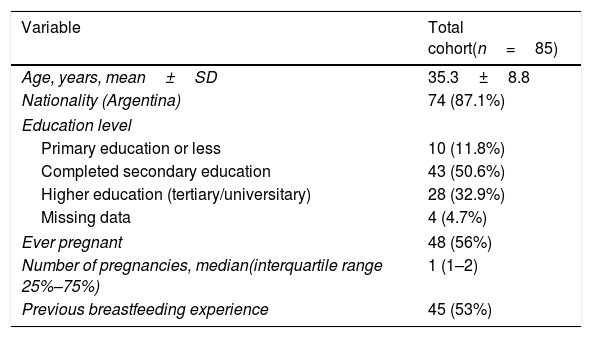
ResultsThe survey was completed by 85 patients. The main demographic and clinical characteristics of the study population are summarized in Table 1. Twenty-eight patients (32.9%) had at least one child after being diagnosed with SLE and were classified as the SLE&Child group.
General characteristics of the study population.
| Variable | Total cohort(n=85) |
|---|---|
| Age, years, mean±SD | 35.3±8.8 |
| Nationality (Argentina) | 74 (87.1%) |
| Education level | |
| Primary education or less | 10 (11.8%) |
| Completed secondary education | 43 (50.6%) |
| Higher education (tertiary/universitary) | 28 (32.9%) |
| Missing data | 4 (4.7%) |
| Ever pregnant | 48 (56%) |
| Number of pregnancies, median(interquartile range 25%–75%) | 1 (1–2) |
| Previous breastfeeding experience | 45 (53%) |
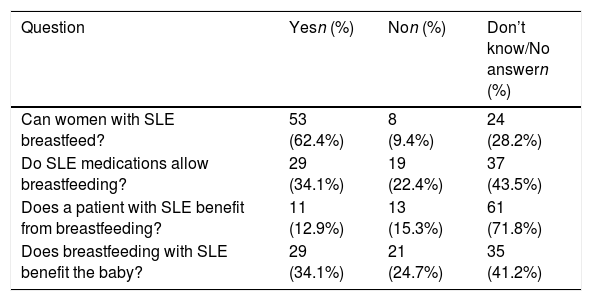
Participants’ baseline knowledge about breastfeeding with SLE is summarized (Table 2).
Participants’ baseline knowledge about breastfeeding in systemic lupus erythematosus (SLE).
| Question | Yesn (%) | Non (%) | Don’t know/No answern (%) |
|---|---|---|---|
| Can women with SLE breastfeed? | 53 (62.4%) | 8 (9.4%) | 24 (28.2%) |
| Do SLE medications allow breastfeeding? | 29 (34.1%) | 19 (22.4%) | 37 (43.5%) |
| Does a patient with SLE benefit from breastfeeding? | 11 (12.9%) | 13 (15.3%) | 61 (71.8%) |
| Does breastfeeding with SLE benefit the baby? | 29 (34.1%) | 21 (24.7%) | 35 (41.2%) |
When considering a future pregnancy, 75 patients (88%) expressed an intention to breastfeed. However, if SLE were active and required medication, 53 patients (62%) indicated that they would prioritize the best available treatment over breastfeeding (p<0.001).
After reviewing the prednisone PILs, 54 patients (64%) believed breastfeeding was possible while taking the medication. In contrast, only 22 patients (26%) felt the same way about hydroxychloroquine.
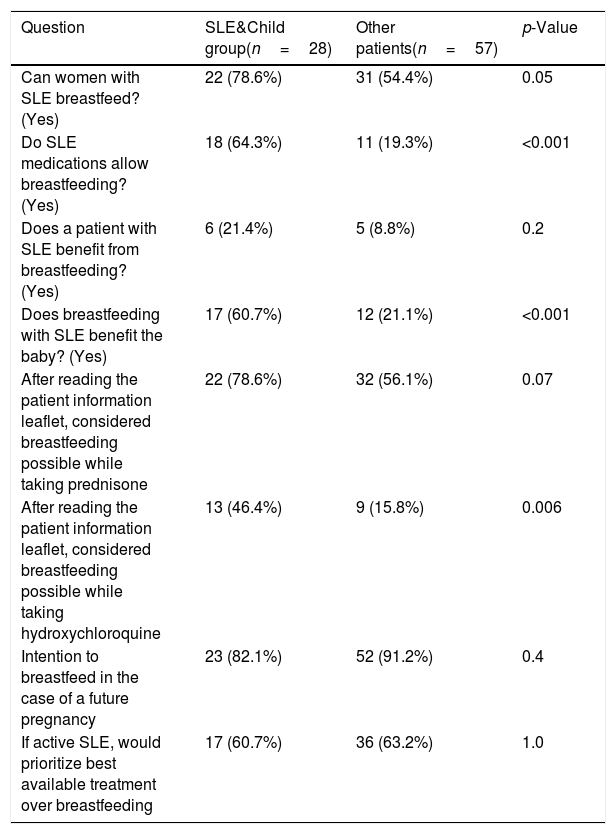
Table 3 presents a comparison of breastfeeding knowledge and perceptions between patients who had a child after being diagnosed with SLE (SLE&Child group) and those who had not.
Comparison of breastfeeding knowledge, perceptions, and intentions between patients who had a child after SLE diagnosis (SLE&Child group) and other patients.
| Question | SLE&Child group(n=28) | Other patients(n=57) | p-Value |
|---|---|---|---|
| Can women with SLE breastfeed? (Yes) | 22 (78.6%) | 31 (54.4%) | 0.05 |
| Do SLE medications allow breastfeeding? (Yes) | 18 (64.3%) | 11 (19.3%) | <0.001 |
| Does a patient with SLE benefit from breastfeeding? (Yes) | 6 (21.4%) | 5 (8.8%) | 0.2 |
| Does breastfeeding with SLE benefit the baby? (Yes) | 17 (60.7%) | 12 (21.1%) | <0.001 |
| After reading the patient information leaflet, considered breastfeeding possible while taking prednisone | 22 (78.6%) | 32 (56.1%) | 0.07 |
| After reading the patient information leaflet, considered breastfeeding possible while taking hydroxychloroquine | 13 (46.4%) | 9 (15.8%) | 0.006 |
| Intention to breastfeed in the case of a future pregnancy | 23 (82.1%) | 52 (91.2%) | 0.4 |
| If active SLE, would prioritize best available treatment over breastfeeding | 17 (60.7%) | 36 (63.2%) | 1.0 |
A total of 29 pregnancies were recorded in 28 patients from the SLE&Child group, compared to 44 pregnancies in 20 patients from the control group, who had experienced pregnancies prior to their SLE diagnosis. Notably, eleven patients in the SLE&Child group had previously experienced pregnancies before their SLE diagnosis and had breastfed at that time.
Breastfeeding was initiated in 23 out of 29 pregnancies (79.3%) in the SLE&Child group, compared to 41 out of 44 pregnancies (93.2%) in the control group (p=0.08).
The average age at the time of delivery was 28 years (SD 6) in the SLE&Child group vs. 22 (SD 5) in the rest (p<0.001). The median education level was 2 (IQR 25–75% 2–3) in the SLE&Child group vs. 2 (IQR 25–75% 1–2) in the rest (p<0.001). Previous breastfeeding experience was reported in 37.9% of the SLE&Child group vs. 47.7% of the rest (p=0.6).
The average duration of breastfeeding was 14 months (SD=10) in the SLE&Child group and 17 months (SD=10) in the control group (log-rank test, p=0.5). In the SLE&Child group, only three patients reported discontinuing breastfeeding due to medication use, and in all three cases, the medication involved was methotrexate.
DiscussionThis study shows that while the majority of SLE patients considered breastfeeding feasible and intended to do so, this percentage significantly decreased in cases of active disease. Additionally, 74% of respondents believed breastfeeding was unsafe after reading the hydroxychloroquine Patient Information Leaflet, despite hydroxychloroquine having a well-established safety profile during both pregnancy and lactation.
Breastfeeding initiation rates among SLE patients vary widely across published studies, ranging from 36.7% to 91%.11–16 This variation, however, appears to be more related to differences in the general population, as described in the “Introduction”. Most studies, with the exception of one from China, suggest that breastfeeding initiation rates in SLE patients are similar to or slightly lower than those reported in the general or control population. In this study, the breastfeeding initiation rate was lower in SLE patients compared to the control group (79.3% vs. 93.2%). These findings align with those of a 2017 case–control study, which reported initiation rates of 80.6% in SLE patients and 94.4% in healthy controls.12 According to official data from Argentina, 91.7% of newborns are breastfed at birth.24 In both studies, small sample sizes may have limited the ability to detect statistically significant differences. Compared to our previously published 2017 study, conducted by the same research team at the same center, we observed that the average duration of breastfeeding in the SLE group has doubled. Additionally, no patients discontinued breastfeeding due to the use of hydroxychloroquine or prednisone.
Finally, a study published in 2025 reported that in Egypt, mothers with SLE showed lower breastfeeding rates and a shorter duration of breastfeeding compared with the control group.25
Noviani et al., in a prospective study,11 found that breastfeeding rates were significantly higher among women who had expressed an intention to breastfeed during pregnancy. However, while 67% of patients planned to breastfeed, only 49% ultimately did. In a prospective study conducted in Italy, 96.5% of patients with SLE intended to breastfeed, but only 71% actually did so, despite all patients being encouraged to breastfeed and rooming-in being practiced (the baby remained with the mother 24h a day unless contraindicated).13 Both the study by Noviani et al.11 and the one by Ikram et al.15 found that women with inactive SLE were more likely to breastfeed. These findings highlight a well-recognized gap between breastfeeding intention and actual breastfeeding behavior in women with SLE. Intention appears to be predominantly influenced by disease-related factors, such as perceived disease activity and concerns regarding medication safety, whereas actual breastfeeding practices are shaped by additional factors, including prior breastfeeding experience, postpartum support, and broader psychosocial and contextual influences. As observed in the present study, the intention to breastfeed may decline when patients perceive their health to be at risk. In this context, patients were asked hypothetically whether active disease would influence their breastfeeding intention; disease activity was not objectively evaluated, which limits the ability to establish objective correlations between disease activity and breastfeeding outcomes.
The use of medication during the postpartum period was identified as a key factor contributing to early weaning among women with SLE.12,15 Mills and Bermas26 reported that while rheumatologists had better knowledge than other healthcare professionals regarding medications compatible with breastfeeding, knowledge gaps persisted across all groups. Similarly, a woman's decision to continue medication during pregnancy was strongly influenced by the information provided by her treating physicians.27,28 Receiving contradictory recommendations from different healthcare providers (rheumatologists, obstetricians, pediatricians) may lead to uncertainty and negatively impact a patient's perception of drug safety.
Data from Latin America addressing breastfeeding-related knowledge, attitudes, self-efficacy, and practices in women with autoimmune rheumatic diseases remain limited. Nevertheless, preliminary evidence from the region, including conference reports from Mexico, suggests that although breastfeeding intention is generally high among women with autoimmune rheumatic diseases, important gaps persist between intention, attitudes, and actual breastfeeding patterns, particularly regarding exclusive breastfeeding. Despite this emerging regional evidence, fully published studies specifically focused on women with systemic lupus erythematosus and addressing patient-level determinants of breastfeeding decisions remain scarce, underscoring the need for context-specific research in Latin America.29,30
The EULAR guidelines published in 2016 state that both hydroxychloroquine and prednisone are compatible with breastfeeding.8 Similarly, the British Society for Rheumatology guideline on prescribing drugs in pregnancy and breastfeeding, published in 2023,9 states that prednisolone is compatible with breastmilk exposure (GRADE 1B, strength of agreement [SOA] 100%) and that HCQ is also compatible with breastmilk exposure (GRADE 1B, SOA 99.5%). However, as Sabando et al.23 highlighted, inconsistencies exist among patient information leaflets (PILs) for these drugs, and not all reflect the most current treatment guidelines.
At the time of manuscript preparation, some patient information leaflets for hydroxychloroquine and prednisone in Argentina had been updated according to the most recent scientific evidence. However, there are still hydroxychloroquine leaflets that omit information about breastfeeding or include general warnings that may cause concern, such as the need to weigh risks and benefits during pregnancy, or still mention that “…infants are known to be extremely sensitive to the toxic effects of 4-aminoquinolines…”, as in the example selected in this study. Similarly, in the case of prednisone, some patient information leaflets warn that the use of high doses of corticosteroids is not recommended during breastfeeding, or directly advise against breastfeeding altogether.
Guidelines on pregnancy and breastfeeding in SLE are developed by experts based on systematic literature reviews and may not always align with the information provided in individual patient information leaflets (PILs).9 This study contributes new insight by identifying the influence of local patient information leaflets (PILs) as a potential barrier to breastfeeding among women with SLE – a factor not previously emphasized in the literature. The finding that most participants perceived breastfeeding as unsafe after reading available PILs in Argentina underscores the need for healthcare professionals to critically review these materials with patients. Addressing inconsistencies and providing updated, evidence-based guidance is essential to support informed decision-making and avoid premature discontinuation of breastfeeding.
Limitations of this studyThis study was conducted at a single public, university-affiliated center located in Argentina's capital city, which may limit the external validity of its findings. Additionally, the sample size (n=85) and the specific clinical and geographic setting may introduce selection bias, restricting the generalizability of the results to broader populations, particularly in different healthcare systems or sociodemographic contexts. Although the education level of participants is described in the “Results”, socioeconomic status and ethnicity were not evaluated. Regarding the statistical analysis, some p-values (e.g., 0.05 and 0.07) are close to significance thresholds and should be interpreted with caution. Moreover, this study did not include effect size estimates or confidence intervals, which would provide better insight into the practical importance of the findings.
The data collection period from October 2022 to February 2024 was intentionally chosen to allow sufficient time for all eligible patients to participate. This timeframe coincided with the hospital's gradual return to full activity following pandemic-related disruptions, which had previously impacted patient flow. We consider this period adequate to achieve representative responses without compromising data reliability. Additionally, the extended period facilitated the inclusion of a diverse sample, enhancing the generalizability of the findings.
Detailed breastfeeding patterns based on standardized definitions (e.g., exclusive, predominant, or partial breastfeeding) were not collected, limiting the characterization of feeding practices.
Finally, some questions were based on clinical experience, and neither formal validation nor pilot testing of the questionnaire was performed, which may affect the reliability and interpretation of the responses.
ConclusionsThis study highlights that, although most patients with SLE consider breastfeeding feasible and express an initial intention to breastfeed, this intention significantly decreases in the context of active disease. Additionally, the perception of medication safety – particularly after reading patient information leaflets (PILs) – can influence breastfeeding decisions. To better support breastfeeding in SLE patients, healthcare professionals must provide consistent, evidence-based guidance, and medication PILs should be updated to reflect the latest scientific evidence. Further large-scale, multicenter studies are needed to enhance our understanding of these challenges and identify strategies to resolve them.
CRediT authorship contribution statementConceptualization and methodology: BCPC, SVP, NJP, MBSG, MIPG, MLM, GS and EMK.
Investigation data: SVP, NJP, MBSG, AB, JC, EG and MIPG.
Funding acquisition: N/A.
Curation, validation, project administration and supervision: BCPC, SVP, NJP, MBSG, EG, MIPG, MLM, GS and EMK.
Resources: BCPC, SVP, NJP, MBSG, AB, JC, EG, MPIG, MLM, GS and EMK.
Formal analysis: SVP, NJP, MPIG and GS.
Visualization, Writing – reviewing and editing: All contributed to the conceptualization, drafting, reviewing, and editing of the manuscript. All authors take full responsibility for the integrity and accuracy of all aspects of the work. They have approved the final version of the manuscript and agreed to be accountable for all parts of the work.
Compliance with ethical standardsAll patients signed informed consent. The study was approved by the Bioethics Committee (Registration Code 4090, June 15, 2022).
FundingThis research received no specific grant from any funding agency in the public, commercial, or not-for-profit sectors.
Conflict of interestThe authors declare that they have no conflict of interest.
For the English translation of this manuscript, the authors utilized ChatGPT-5.2 to enhance readability and language. All content was then reviewed and edited by the authors, who take full responsibility for the final version.
The following are the supplementary data to this article:

This study was presented, in part, as a poster at the ACR Convergence 2023 (Arthritis Rheumatol. 2023; 75 (suppl 9). https://acrabstracts.org/abstract/breastfeeding-intention-in-systemic-lupus-erythematosus-patients/).