


Systemic sclerosis (SSc) is characterized by exuberant fibrosis, caused by severe vasculopathy and vasospasm. Despite the impact of the disease on survival, epidemiological and comorbidity data on SSc are currently limited in Mexico.
MethodsObservational, cross-sectional, and descriptive clinical study. Patients with SSc according to the 2013 ACR/EULAR criteria from 2 public healthcare centres in northeastern Mexico from the IMSS were included. Sociodemographic, clinical, and laboratory variables were collected. The prevalence of comorbidities reported by the patients was investigated. Serology, transthoracic ultrasound, and high-resolution chest computed tomography were performed.
Results68 patients with SSc were included: 65 (95.3%) women, with a mean age of 51.5 ± 9.86 years, with the following distribution: 50 (73.5%) limited, 7 (10.3%) diffuse, 11 overlap (16.2%), 22 (32.3%) with systemic arterial hypertension, 14 (20.5%) with obesity.
ConclusionsThe detection of systemic arterial hypertension, the most frequent comorbidities in multiple populations, could prevent cardiovascular complications.
La esclerosis sistémica (ES) se caracteriza por una fibrosis exuberante, que se origina por una vasculopatía y vasoespasmo grave, A pesar del impacto de la enfermedad en la supervivencia los datos de epidemiología y comorbilidades en la ES hasta el momento son limitados en México.
Materiales y métodosEstudio clínico observacional, transversal y descriptivo. Se incluyeron pacientes con ES según los criterios ACR/ EULAR 2013 de 2 centros de atención pública del noreste de México del IMSS, Se recogieron variables sociodemográficas, clínicas y analíticas Se investigaron la prevalencia de comorbilidades reportadas por los pacientes, Se Realizó Serología, Ecografía transtorácica y la Tomografía de alta resolución de tórax.
ResultadosSe incluyeron 68 pacientes con ES 65 (95.3%) Mujeres, con una edad media de 51.5 ± 9.86 Años, con la siguiente distribución: 50 (73.5%) limitada, 7 (10.3%) difusa, 11 (16.2%) con sobreposicion, 22 (32.3%) con Hipertensión Arterial sistémica, 14 (20.5%) con obesidad.
ConclusionesLa detección de hipertensión arterial sistémica la más frecuente de las comorbilidades en múltiples poblaciones podría prevenir complicaciones cardiovasculares.
Systemic sclerosis (SSc) is expressed by exuberant fibrosis of the skin, gastrointestinal tract, heart, lungs, and kidneys, and is complicated by extensive vasculopathy with severe vasospasm and progressive vascular obliteration.1 The aetiology of SSc is multifactorial, and the pathological processes are driven by environmental and genetic factors, leading to early inflammation, followed by lymphohistiocytic infiltrates in the affected vessels and fibrosis.2
It is a rare disease that significantly affects quality of life and has one of the highest mortality rates among the various autoimmune diseases.3 Comorbidities that may be present include dyslipidemia; type II diabetes mellitus; hypertension; smoking; coronary artery disease (CAD); cerebrovascular disease; chronic obstructive pulmonary disease; osteoporosis; neoplasms, and depression.
Despite the impact of the disease on survival and quality of life, data on the epidemiology and clinical expression of comorbidities in systemic sclerosis (SSc) are currently limited in the Mexican population.
Materials and methodsThis was an observational, cross-sectional, and descriptive clinical study. Consecutive patients over 18 years of age, diagnosed with progressive SSc according to the 2013 ACR/EULAR criteria, were included between January 2024 and January 2025 from two public healthcare centres in North-eastern Mexico belonging to the Mexican Social Security Institute (High Specialty Medical Unit #71 and General Zone Hospital #11). Scleroderma subtypes were defined according to the EULAR classification. Patients with a confirmed diagnosis of mixed connective tissue disease, as well as those with localised SSc variants, were excluded. Sociodemographic, clinical, and laboratory variables were collected cross-sectionally at the time of enrolment by certified rheumatologists.
The prevalence of the following comorbidities reported by patients was investigated: type II diabetes mellitus; systemic hypertension; dyslipidemia; mood disorders; depression; anxiety; peripheral arterial insufficiency; smoking; alcoholism; osteoporosis; obesity; neoplasms; thyroid disorders (hypothyroidism); fibromyalgia; congestive heart failure, and autoimmune diseases.
Anticellular antibody serology was performed by indirect immunofluorescence (IIF). Anti-Scl70, anticentromere, and anti-RNP antibodies were determined by ELISA immunoassay. The presence of pulmonary hypertension was evaluated by transthoracic ultrasound, and the presence of interstitial lung disease was assessed by high-resolution computed tomography of the chest, with findings consistent with a ground-glass opacity or honeycomb pattern considered positive.
Statistical analysisStatistical analysis was performed using SPSS® version 25. Categorical data were expressed as percentages, while continuous variables were presented using mean and standard deviation (SD) after determining normality by Kolmogorov-Smirnov (KS) test.
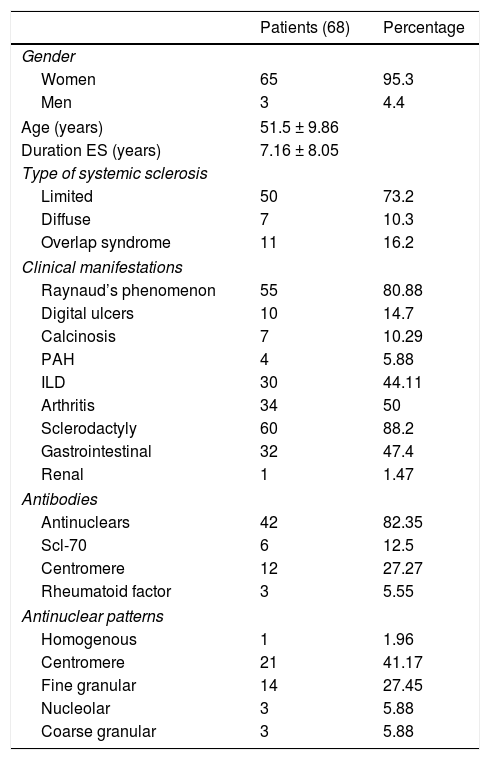
ResultsSixty-eight patients diagnosed with systemic sclerosis (SSc) were recruited: 65 (95.3%) women and 3 (4.4%) men, with a mean age of 51.5 ± 9.86 years. The mean duration of SSc at the time of inclusion in the study was 7.16 ± 8.05 years, with the following distribution: 50 (73.5%) limited, 7 (10.3%) diffuse, and 11 (16.2%) with overlapping forms. No patients had the sine scleroderma variant.
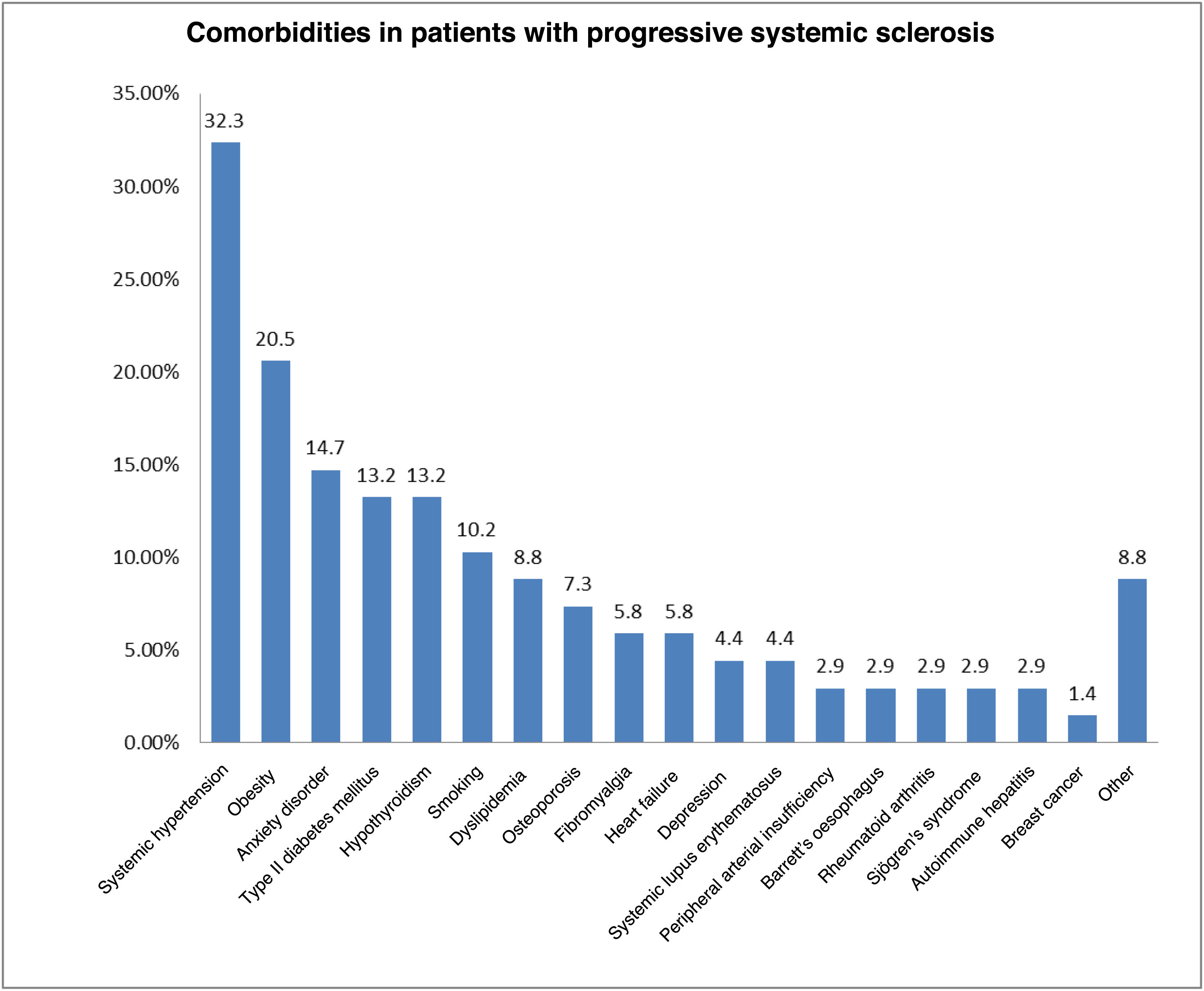
An average of 1.65 comorbidities per patient was documented, with 22 (32.3%) having systemic hypertension, 14 (20.5%) obesity, 10 (14.7%) anxiety disorder, and 9 (13.2%) (Fig. 1).
Regarding clinical manifestations: Raynaud’s phenomenon 55 (80.88%); digital ulcers 10 (14.70%); calcinosis 7 (10.29%); pulmonary arterial hypertension (PAH) 4 (5.88%); interstitial lung disease (ILD) 30 (44.11%); arthritis 34 (50.0%); sclerodactyly 60 (88.2%); gastrointestinal involvement 32 (47.4%); renal involvement 1 (1.47%), and medication use (Table 1).
Demographic and clinical characteristics.
| Patients (68) | Percentage | |
|---|---|---|
| Gender | ||
| Women | 65 | 95.3 |
| Men | 3 | 4.4 |
| Age (years) | 51.5 ± 9.86 | |
| Duration ES (years) | 7.16 ± 8.05 | |
| Type of systemic sclerosis | ||
| Limited | 50 | 73.2 |
| Diffuse | 7 | 10.3 |
| Overlap syndrome | 11 | 16.2 |
| Clinical manifestations | ||
| Raynaud’s phenomenon | 55 | 80.88 |
| Digital ulcers | 10 | 14.7 |
| Calcinosis | 7 | 10.29 |
| PAH | 4 | 5.88 |
| ILD | 30 | 44.11 |
| Arthritis | 34 | 50 |
| Sclerodactyly | 60 | 88.2 |
| Gastrointestinal | 32 | 47.4 |
| Renal | 1 | 1.47 |
| Antibodies | ||
| Antinuclears | 42 | 82.35 |
| Scl-70 | 6 | 12.5 |
| Centromere | 12 | 27.27 |
| Rheumatoid factor | 3 | 5.55 |
| Antinuclear patterns | ||
| Homogenous | 1 | 1.96 |
| Centromere | 21 | 41.17 |
| Fine granular | 14 | 27.45 |
| Nucleolar | 3 | 5.88 |
| Coarse granular | 3 | 5.88 |
ILD: Interstitial lung disease; PAH: Pulmonary arterial hypertension.
Systemic hypertension (32.3%), followed by obesity (20.5%) and general anxiety disorder (14.7%), were the most frequently reported comorbidities among patients with progressive systemic sclerosis in North-eastern Mexico at two public healthcare centres.
Gottschalk et al.,4 in a retrospective cohort of 26 Latin American patients, reported systemic hypertension as the most frequent comorbidity in both patients with limited systemic sclerosis (45.5%) and diffuse systemic sclerosis (26.7%), followed by dyslipidemia and type II diabetes mellitus. No patients with obesity were recorded in this study, unlike in our population, where obesity was the second most frequent comorbidity at 20.5%. Martina Orlandi et al.,5 in the Italian SPRING registry of 1,910 patients, reported a systemic hypertension rate of 23.7% and an osteoporosis rate of 12.9%, the latter being higher than the 7.3% observed in our population.
Panopoulos et al.6 compared the prevalence of comorbidities in patients with progressive systemic sclerosis (SSc) and rheumatoid arthritis (n = 480 per group) in six rheumatology departments in Greece. The most frequent comorbidity in both groups was systemic hypertension (32.1% vs. 30.6%), followed by osteoporosis (24%) and depression (22.1%) in the SSc group. Namas et al.,7 in a retrospective national multicentre study in the United Arab Emirate, with 90 patients distributed between 44 with diffuse variant and 46 with localised variant, had a comorbidity distribution of 48% presence of iron deficiency anaemia, 27.7% systemic arterial hypertension and 24.4% type 2 diabetes mellitus. Fauthoux et al.,8 in a retrospective cohort of 400 patients in a French hospital care centtr, evaluated the causes of death in patients with SSc associated with the 14 comorbidities studied, the most prevalent being polypharmacy, smoking and cardiovascular comorbidities, affecting up to 30%, documented a relationship between mortality and the presence of neoplasms, polypharmacy and cardiovascular comorbidities (systemic arterial hypertension, stroke, myocardial infarction) highlighting the importance of the systematic search for comorbidities in patients with SSc.
Fajardo-Hermosillo et al.,9 in a case-control study of 80 Mexican patients with progressive systemic sclerosis from the Rheumatology Service of the Hospital de Especialidades del Centro Médico de Occidente of the Mexican Social Security Institute, during the period from October 2021 to November 2022, described the factors associated with interstitial lung disease, which was present in 47.5% of the patients. In our study, this manifestation was present in 44.1%. Likewise, the distribution pattern was similar between both populations: limited (83.6% vs. 72.1%) and diffuse (12.5 vs. 10.3%). In that study, the presence of smoking was only evaluated in 41.3% of patients compared to 10.2% in our patients.
Núñez et al.,10 in a longitudinal cohort study of 109 patients in the southern United States, compared Hispanic (67%) and non-Hispanic (33%) patients with systemic sclerosis (SSc). They found similar profiles in terms of clinical and serological manifestations, comorbidity prevalence, and mortality. Among the reported cases, ANA positivity was 82.2%, similar to that found in our population. The differences lay in the specific antibodies: anticentromere (45.2% vs. 27.2%) and anti-Scl70 (20.5% vs. 12.5%).
Rodriguez Reyna et al.,11 in 139 Mexican Mestizo patients with SSc from the central part of the country during the period of January 2007 and July 2009 at the National Institute of Medical Sciences and Nutrition Salvador Zubirán, reported the most prevalent clinical and serological manifestations. These were: 91% peripheral vascular involvement, 70% joint involvement; 27% musculoskeletal; 41% interstitial lung disease; 32% pulmonary arterial hypertension; 11% cardiac involvement and 1.4% renal, 66% gastrointestinal. The prevalence of ILD was similar (41% vs. 44.1%); renal (1.4% and 1.4%); peripheral vascular 91% vs. peripheral vascular disease components in our study (80.8% Raynaud’s phenomenon, 14.7% digital ulcers). However, they reported a higher prevalence of gastrointestinal involvement (66% vs. 47.4%), pulmonary arterial hypertension (PAH) (32% vs. 5.88%), and joint involvement (70% vs. 50%).
Peralta-Amaro et al.12 reported a 36.4% prevalence of metabolic syndrome in Mexican patients with progressive systemic sclerosis at the “Dr. Antonio Fraga Mouret” centre of the Centro Médico Nacional La Raza, which was similar to that observed in other rheumatic diseases, but higher than in the general population. Compared to our population in northern Mexico, high levels of the components of metabolic syndrome were observed (systemic hypertension 32.3%, obesity 20.5%, type II diabetes mellitus 13.4%), although this variable was not strictly quantified.
Hudson et al.13 reported low sensitivity and moderate specificity and positive predictive value for comorbidity reporting by SSc patients, thus limiting their detection. On the other hand, diabetes, hypertension, and depression were the comorbidities with the best sensitivity for self-reporting, which enabled their detection and was consistent with their frequency in our population.
The limitations of this study were the self-reported comorbidity detection method, which has limited performance, and the limited number of participating centres, which were geographically dispersed and did not include the central and southern regions of the country.
However, despite its limitations, this study provides an overview of comorbidities in Mestizo/Mexican patients with progressive systemic sclerosis, in a population that receives little attention in the country.
ConclusionsThe targeted search for comorbidities in patients with progressive systemic sclerosis can improve quality of life and prevent cumulative damage synergistic with disease activity. In particular, the detection of systemic hypertension, the most frequent comorbidity in multiple populations, could prevent cardiovascular complications to which these patients are more prone.
Ethical considerationsInformed consent was obtained for participation, and data handling was conducted in accordance with the internal regulations of the Mexican Social Security Institute, guaranteeing data protection and patient privacy, and adhering to the ethical principles of the Declaration of Helsinki.
The authors have no conflict of interests to declare.