


To describe the clinical, immunological, and healthcare characteristics of patients attended in a Pediatric Rheumatology unit of a tertiary Spanish hospital over ten years.
MethodsRetrospective observational study including all patients under 18 years evaluated between 2014 and 2024. Demographic data, diagnoses, immunological profile, presence of uveitis, treatments, and final healthcare status were collected.
ResultsA total of 925 patients were evaluated; 59.8% were female. The most prevalent disease in the clinic was JIA (29.4%), with oligoarticular JIA being the most frequent subtype (49.2%), of whom 71.5% were positive for ANA and 17.7% had uveitis. Autoinflammatory diseases accounted for 10.2% and connective tissue diseases for 7.4%. At the time of analysis, 45.3% were still followed in paediatric care, and 9% were in transition to adult consultations.
ConclusionsOur case series is similar to that described in other Pediatric Rheumatology units in our region, highlighting the higher frequency of oligoarticular JIA and its association with positive ANA.
Describir las características clínicas, inmunológicas y asistenciales de pacientes atendidos en una unidad de Reumatología Pediátrica de un hospital terciario español durante diez años.
MétodosEstudio observacional retrospectivo que incluyó a todos los pacientes menores de 18 años valorados entre 2014 y 2024. Se recogieron datos demográficos, diagnósticos, perfil inmunológico, presencia de uveítis, tratamientos y situación asistencial final.
ResultadosSe evaluaron 925 pacientes; el 59,8% fueron mujeres. La enfermedad más prevalente en la consulta fue la AIJ (29,4%) y, dentro de este grupo, la más frecuente fue la AIJ oligoarticular (49,2%), presentando en un 71,5% ANA positivos y en un 17,7% uveítis. Las enfermedades autoinflamatorias supusieron el 10,2% y las conectivopatías el 7,4%. En el momento del análisis, el 45,3% mantenía seguimiento pediátrico y el 9% se encontraba en transición a consultas de adultos.
ConclusionesNuestra casuística es similar a la descrita en otras unidades de Reumatología Pediátrica de nuestro entorno, destacando la mayor frecuencia de AIJ oligoarticular y su asociación con ANA positivo.
Paediatric rheumatology is a specialised area focused on the study of inflammatory and autoimmune diseases in children and adolescents. These conditions are expressed by chronic inflammation that can affect the musculoskeletal system, skin, blood vessels, and other organs, with functional and clinical repercussions in early stages of life.1
Among the most frequent diseases evaluated in paediatric rheumatology clinics are juvenile idiopathic arthritis (JIA), the leading cause of chronic arthritis in childhood,2 systemic autoimmune diseases such as systemic lupus erythematosus (SLE), juvenile dermatomyositis (JDM), and various auto inflammatory diseases.3
The physiological, clinical, and social characteristics of rheumatic diseases in children necessitate specialised care based on specific diagnostic criteria and tailored follow-up strategies.2
Furthermore, given the chronic nature of these pathologies, it is essential to develop transition programmes to adult rheumatology that guarantee clinical and therapeutic continuity, reducing the risk of loss of patient follow-up.4
Against this backdrop, understanding the real-world data from our clinical practice—which patients we treat, how they present, and how their care is organised—is essential for adapting available resources and strengthening transition programmes to adult units.
ObjectiveThe objective of this study is to describe the clinical, immunological, and care characteristics of a cohort of patients treated in a Paediatric Rheumatology unit at a Spanish tertiary hospital over a 10-year period.
Material and methodsA retrospective, descriptive, observational study was conducted, including 925 patients evaluated in the Paediatric Rheumatology clinic of the Miguel Servet University Hospital (Zaragoza, Spain) over the past 10 years, from January 2014 to December 2024.
Electronic medical records from the Aragonese Health Service were reviewed, and demographic variables, final diagnosis, year of diagnosis, recorded comorbidities, presence of uveitis, immunological parameters, and treatments used were collected.
Diagnoses were established according to current international criteria for each condition, including the ILAR/PRINTO criteria for juvenile idiopathic arthritis (JIA) and the EULAR/ACR recommendations for connective tissue diseases and autoinflammatory diseases.
In addition, the patient's care status at the end of the follow-up period was recorded and classified into three categories: discharge, follow-up in a paediatric clinic, or referral to an adult transition clinic.
No additional procedures or specific complementary tests were performed, given the retrospective nature of the analysis. A descriptive analysis was carried out using Jamovi software, expressing quantitative variables using appropriate measures of central tendency and dispersion, and qualitative variables as absolute frequencies and percentages.
The study was approved by the Research Ethics Committee of Aragon.
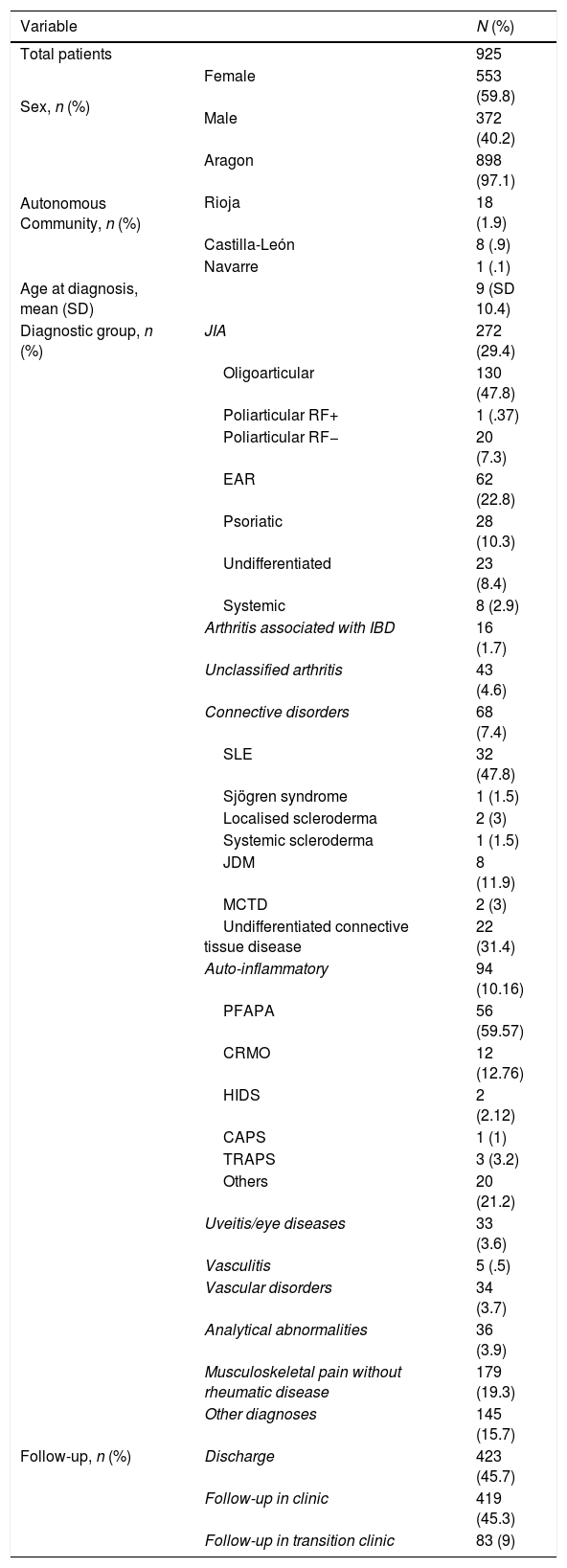
ResultsThe demographic characteristics of the patients included in the study and the prevalence of rheumatic diseases assessed in the clinic are described in Table 1.
Demographic characteristics of the patients assessed in the paediatric rheumatology clinic and prevalence of the main rheumatic diseases diagnosed.
| Variable | N (%) | |
|---|---|---|
| Total patients | 925 | |
| Sex, n (%) | Female | 553 (59.8) |
| Male | 372 (40.2) | |
| Autonomous Community, n (%) | Aragon | 898 (97.1) |
| Rioja | 18 (1.9) | |
| Castilla-León | 8 (.9) | |
| Navarre | 1 (.1) | |
| Age at diagnosis, mean (SD) | 9 (SD 10.4) | |
| Diagnostic group, n (%) | JIA | 272 (29.4) |
| Oligoarticular | 130 (47.8) | |
| Poliarticular RF+ | 1 (.37) | |
| Poliarticular RF− | 20 (7.3) | |
| EAR | 62 (22.8) | |
| Psoriatic | 28 (10.3) | |
| Undifferentiated | 23 (8.4) | |
| Systemic | 8 (2.9) | |
| Arthritis associated with IBD | 16 (1.7) | |
| Unclassified arthritis | 43 (4.6) | |
| Connective disorders | 68 (7.4) | |
| SLE | 32 (47.8) | |
| Sjögren syndrome | 1 (1.5) | |
| Localised scleroderma | 2 (3) | |
| Systemic scleroderma | 1 (1.5) | |
| JDM | 8 (11.9) | |
| MCTD | 2 (3) | |
| Undifferentiated connective tissue disease | 22 (31.4) | |
| Auto-inflammatory | 94 (10.16) | |
| PFAPA | 56 (59.57) | |
| CRMO | 12 (12.76) | |
| HIDS | 2 (2.12) | |
| CAPS | 1 (1) | |
| TRAPS | 3 (3.2) | |
| Others | 20 (21.2) | |
| Uveitis/eye diseases | 33 (3.6) | |
| Vasculitis | 5 (.5) | |
| Vascular disorders | 34 (3.7) | |
| Analytical abnormalities | 36 (3.9) | |
| Musculoskeletal pain without rheumatic disease | 179 (19.3) | |
| Other diagnoses | 145 (15.7) | |
| Follow-up, n (%) | Discharge | 423 (45.7) |
| Follow-up in clinic | 419 (45.3) | |
| Follow-up in transition clinic | 83 (9) |
CAPS: cryopyrin-associated periodic syndromes; CRMO: chronic recurrent multifocal osteomyelitis; EAR: enthesitis-associated arthritis; HIDS: hyper-IgD syndrome; JDM: juvenile dermatomyositis; JIA: juvenile idiopathic arthritis; MCTD: mixed connective tissue disease; RF: rheumatoid factor; SLE: systemic lupus erythematosus; TRAPS: tumour necrosis factor-associated periodic syndromes.
Within the study sample, 59.8% were girls 97.1% were from the autonomous community of Aragon, of which 84.85% were from the province of Zaragoza. The mean age at diagnosis was 9 years (SD 10.4).
Of the 925 patients assessed in the clinic, 19.3% presented with musculoskeletal pain without criteria for rheumatic disease, and 15.7% received alternative non-rheumatological diagnoses. Thirty-four per cent were assessed in the clinic for vascular abnormalities, primarily Raynaud's phenomenon, and 36% for immunological abnormalities without well-defined clinical presentation.
Regarding rheumatological diagnoses, juvenile idiopathic arthritis (JIA) was the most frequent entity (29.4%), followed by autoinflammatory diseases (10.2%) and connective tissue diseases (7.4%).
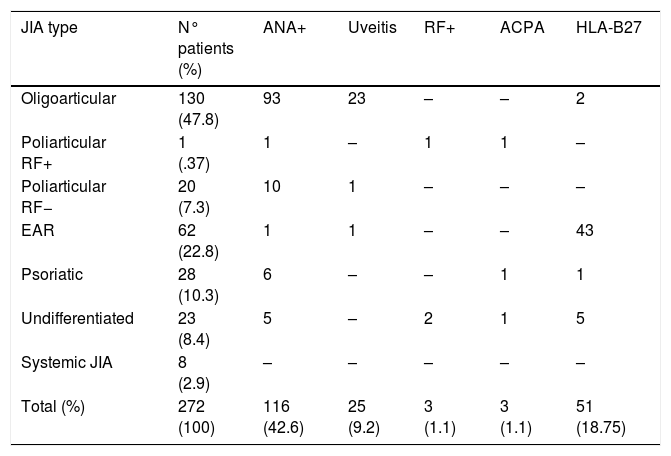
Within JIA, the most frequent form was oligoarticular (47.8%), followed by enthesitis-related arthritis (22.8%) and the psoriatic form (10.3%). Systemic JIA represented 2.9% of cases (8 patients), of which 25% (2 patients) developed macrophage activation syndrome (MAS). The mean age at diagnosis was 7.38 years (SD 4.56). In the immunological analysis, 42.6% presented with positive antinuclear antibodies (ANA), and 9.2% developed uveitis, more frequently in the oligoarticular form. RF and ACPA positivity was infrequent (1.1% for both), while HLA-B27 was detected in 18.8%, primarily in enthesitis-related forms (Table 2).
Diagnosis and association with ANA+, uveitis, RF+, ACPA+, HLA-B27+.
| JIA type | N° patients (%) | ANA+ | Uveitis | RF+ | ACPA | HLA-B27 |
|---|---|---|---|---|---|---|
| Oligoarticular | 130 (47.8) | 93 | 23 | – | – | 2 |
| Poliarticular RF+ | 1 (.37) | 1 | – | 1 | 1 | – |
| Poliarticular RF− | 20 (7.3) | 10 | 1 | – | – | – |
| EAR | 62 (22.8) | 1 | 1 | – | – | 43 |
| Psoriatic | 28 (10.3) | 6 | – | – | 1 | 1 |
| Undifferentiated | 23 (8.4) | 5 | – | 2 | 1 | 5 |
| Systemic JIA | 8 (2.9) | – | – | – | – | – |
| Total (%) | 272 (100) | 116 (42.6) | 25 (9.2) | 3 (1.1) | 3 (1.1) | 51 (18.75) |
EAR: enthesitis-associated arthritis; JIA: juvenile idiopathic arthritis; RF: Rheumatoid factor.
Auto-inflammatory diseases accounted for 10.2% of the total, with a mean age at diagnosis of 6.64 years (SD 4.13). PFAPA syndrome was the most frequent diagnosis (59.6%), followed by CRMO (12.8%).
Connective tissue diseases accounted for 7.4% of the total, with a mean age at diagnosis of 11.7 years (SD 3.36) and a predominance of females (83.8%). Systemic lupus erythematosus (SLE) was the most common entity (47.8%), followed by juvenile dermatomyositis (11.9%).
At the time of analysis, 45.3% of patients were still under follow-up, 45.7% had been discharged, and 9% were in the process of transitioning to adult rheumatology clinics.
DiscussionIn our cohort, juvenile idiopathic arthritis (JIA) was the most frequent disease, especially oligoarticular ANA-positive JIA. These data are consistent with those obtained in European registries where JIA is the main disease evaluated in rheumatology clinics.5
Likewise, the incidence of uveitis observed in our study is similar to previously published data.4 The high frequency of positive ANA and uveitis reinforces the need for early ophthalmological screening, as described in previous studies.6
Regarding connective tissue diseases, systemic lupus erythematosus (SLE) was the most prevalent pathology, as in most studies, which highlight the importance of specific care models for managing this disease in childhood.7
Regarding transition to adult rheumatology, only 9% of patients had begun this process at the time of analysis. This percentage should be interpreted within its chronological context, given that the transition clinic was formally implemented in recent years, meaning that many patients seen during the initial study period did not have access to this clinic. This data reflects not only the recent implementation of the programme but also the need to progressively consolidate it to ensure continuity of care. The importance of a structured, multidimensional, and coordinated process between paediatricians and adult rheumatologists has been widely described, highlighting that the implementation of transition models requires planning, professional training, and interdepartmental collaboration.8
Limitations of this study include its retrospective, single-centre design. However, the sample size, long follow-up period, and systematic collection of immunological variables lend robustness and representativeness to the results.
To sum up, our results highlight the importance of early recognition and management of paediatric rheumatic diseases, accurate clinical and immunological characterisation, and coordinated care pathways that adequately integrate the transition to adult care.
ConclusionOur case series is similar to that published in other Paediatric Rheumatology units in our region, confirming the high frequency of oligoarticular juvenile idiopathic arthritis (JIA) and its close association with positive antinuclear antibodies (ANA), which reinforces the need for early ophthalmological screening for uveitis detection.
This cohort provides an updated view of the paediatric rheumatological profile in our environment and identifies priority lines of research, including the optimisation of transition strategies and the evaluation of long-term clinical outcomes.
None.