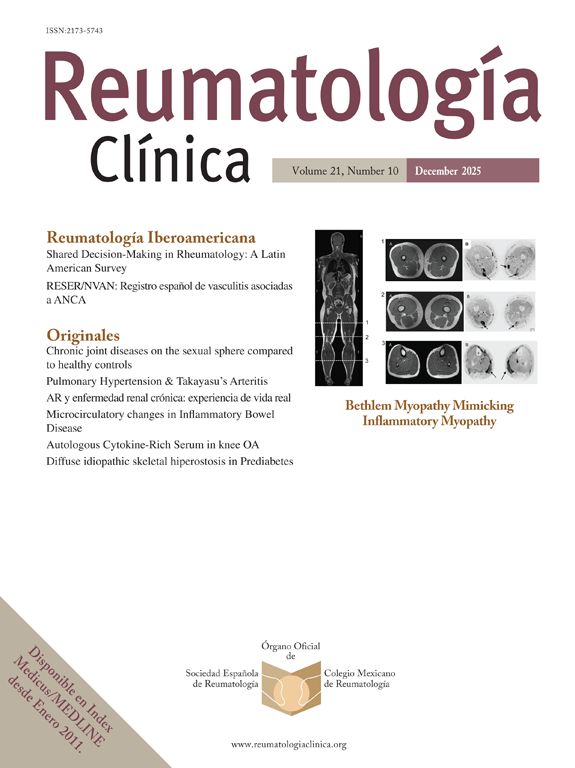

Journal Information
Vol. 21. Issue 10.
(December 2025)
Share
Download PDF
More article options
Visits
1
Vol. 21. Issue 10.
(December 2025)
Original Article
A novel Autologous Cytokine-Rich Serum (SARC) to treat knee osteoarthritis patients’ refractory to a previous glucocorticoid intra-articular injection. A pilot study
Un nuevo suero autólogo rico en citoquinas (SARC) para el tratamiento de la artrosis de rodilla refractaria a infiltración intraarticular de glucocorticoides. Estudio piloto
Visits
1
Cristóbal Orellanaa, Silvia Garcia Cireraa, Albert Rodrigo Parésa, Laia Uriel Brotonsb, Àlex Arqué Corredorb, Cristina Aymericha, Rafael Gómeza, Anna Carrerasa, Antoni Berenguer-Llergoa, Joan Calveta,
Corresponding author
jcalvet@tauli.cat

Corresponding author.
a Department of Rheumatology, Parc Taulí Hospital Universitari, Institut d’Investigació i Innovació Parc Taulí (I3PT-CERCA), Universitat Autònoma de Barcelona, Sabadell, Spain
b Tecnologia Regenerativa Qrem S.L., Sant Pere d’Abanto, 4, 08014 Barcelona, Spain
This item has received
Article information
Abstract
Full Text
Bibliography
Download PDF
Statistics
Figures (2)
Tables (4)
Table 1. Baseline patients’ characteristics and follow-up completion of patients in the complete series (all), and those receiving a single (one dose) or three (three doses) SARC intra-articular injections. Continuous parameters are presented as medians with ranges (minimum to maximum values), and categorical variables are expressed as absolute frequencies and percentages. p-Values were derived from Mann–Whitney tests for continuous variables, and Fisher's tests for contingency tables for categorical variables.
Tables
Table 2. Rate of response to SARC intra-articular injections for 20% improvement over follow-up visits. The cells display the percentages of patients who achieved a 20% improvement in pain or functional disability, as indicated by their reversed KOOS scores. The data was recorded during follow-up visits at 15 days, one month, three months, six months, and one year after their treatment, and was compared to baseline scores (recruitment). Results are stratified by patients who received either a single or three doses. Withdrawals were treated as non-responders in all cases. Baseline data was missing for one patient from the single-dose group. p-Values show the statistical significance for the differences between the dosing regimens, and were derived from a Fisher's tests for contingency tables.
Tables
Table 3. Pain improvement after SARC intra-articular injections. The cells display the decrease in pain perception according to the KOOS score at 15 days, one month, three months, six months, and one year after their treatment with SARC intra-articular injections. Results are stratified by patients who received either a single or three doses. p-Values express the statistical significance of the score decrease being different from zero, indicating a significant improvement in pain perception. p-Values and 95% confidence intervals (95% CI) were derived from a mixed-effects linear model where time point, number of injections and their interaction were included as explanatory fixed effects, and patients were parametrized as a random effect.
Tables
Table 4. Improvement in function disability after SARC intra-articular injections. The cells display the decrease in perception of function disability according to the KOOS score at 15 days, one month, three months, six months, and one year after their treatment with SARC intra-articular injections. Results are stratified by patients who received either a single or three doses. p-Values express the statistical significance of the score decrease being different from zero, indicating a significant improvement in pain perception. p-Values and 95% confidence intervals (95% CI) were derived from a mixed-effects linear model where time point, number of injections and their interaction were included as explanatory fixed effects, and patients were parametrized as a random effect.
Tables
Show moreShow less
Additional material (1)
Abstract
Background

At present, there is a lack of treatments specifically designed to target knee osteoarthritis (KOA). Various intra-articular products have widespread and become commonplace in clinical practice, despite a scarcity of evidence supporting this procedure. Among these, SARC stands out as a novel Autologous Cytokine-Rich Serum derived from the patient's own platelets and white blood cells. This pilot study aims to assess the effectiveness of SARC treatment by measuring improvements in pain and physical disability in patients with symptomatic KOA.

Methods

We recruited 40 symptomatic KOA patients with Kellgren–Lawrence stage 2 or 3, who had been refractory to glucocorticoid intra-articular treatment in the past year. They were assigned to two regimens (single vs. three-dose administrations), and were evaluated for their change in pain and physical function using the KOOS questionnaires at various time points over one year.

Results

At one year after treatment, 36% and 33% of patients achieved a 20% improvement in pain and functional disability, respectively. Patients treated with three intra-articular SARC injections showed a slightly higher improvement (40%) than the single-dose group (26–32%), although differences were not statistically significant. In average, both reversed KOOS scores showed significant improvements compared to baseline, especially for the three-dose group (14 and 16 points, respectively; p-values <0.0001). No adverse events were reported during the study.

Conclusion

A notable proportion of patients with KOA refractory to a previous glucocorticoid injection responded positively to intra-articular SARC treatment. Further studies are required to validate these findings and identify biomarkers of treatment response.

Keywords:
KOA
SARC
Intra-articular treatment
Pain improvement
Treatment response
Personalized medicine
Resumen
Antecedentes

Actualmente, existe una carencia de tratamientos específicamente diseñados para tratar la artrosis de rodilla (KOA). Se han testado distintos productos intraarticulares en pràctica clínica aunque con escasa evidencia. Entre ellos, destaca el SARC, un novedoso Suero Autólogo Rico en Citoquinas derivado de las propias plaquetas y leucocitos del paciente. Este estudio piloto tiene como objetivo evaluar la eficacia del tratamiento con SARC mediante la medición de la mejoría del dolor y la discapacidad física en pacientes con KOA sintomática.

Métodos

Se reclutaron 40 pacientes con KOA sintomática en estadio 2 o 3 de Kellgren-Lawrence, que no habían respondido al tratamiento intraarticular con glucocorticoides en el último año. Los participantes fueron asignados a dos regímenes (una única administración contra tres administraciones), evaluándose el cambio en el dolor y la función física mediante los cuestionarios KOOS en distintos puntos temporales durante un año.

Resultados

Al año del tratamiento, el 36% y el 33% de los pacientes alcanzaron una mejoría del 20% en el dolor y en la discapacidad funcional, respectivamente. Los pacientes tratados con tres inyecciones intraarticulares de SARC mostraron una mejora ligeramente superior (40%) que el grupo de dosis única (26%-32%), aunque las diferencias no fueron estadísticamente significativas. En promedio, ambas puntuaciones KOOS invertidas mostraron mejoras significativas respecto al inicio, especialmente en el grupo de tres dosis (14 y 16 puntos, respectivamente; valores de p<0,0001). No se observaron eventos adversos durante el estudio.

Conclusión

Una proporción relevante de pacientes con KOA refractaria a una inyección previa de glucocorticoides respondió positivamente al tratamiento intraarticular con SARC. Se requieren estudios adicionales para validar estos hallazgos e identificar biomarcadores de respuesta al tratamiento.

Palabras clave:
AR
SARC
Tratamiento intraarticular
Mejora del dolor
Respuesta al tratamiento
Medicina personalizada

Article

These are the options to access the full texts of the publication Reumatología Clínica (English Edition)
Member
If you are member of Sociedad Española de Reumatología (SER) or the Colegio Mexicano de Reumatología (CMR):
Please go to the member area of SER or CMR and log in.
Subscriber
Subscriber

If you already have your login data, please click here .

If you have forgotten your password you can you can recover it by clicking here and selecting the option “I have forgotten my password”
Subscribe
Subscribe to

Reumatología Clínica (English Edition)

Purchase
Purchase article

Purchasing article the PDF version will be downloaded

Purchase now
Contact
Phone for subscriptions and reporting of errors
From Monday to Friday from 9 a.m. to 6 p.m. (GMT + 1) except for the months of July and August which will be from 9 a.m. to 3 p.m.
Calls from Spain
932 415 960
Calls from outside Spain
+34 932 415 960
Email
Idiomas
Reumatología Clínica (English Edition)
Article options
Tools
Supplemental materials