

Journal Information
Vol. 21. Issue 6.
(June - July 2025)
Letter to the Editor
Full text access
Paradoxical reaction after switching between adalimumab biosimilars in a patient with psoriatic arthritis
Reacción paradójica tras el cambio entre biosimilares de adalimumab en un paciente con artritis psoriásica
Visits
38
Mariano F. Palatnika,b,1, Emilce S. Fonsecaa,1, María Lorena Brancea,b,c,1,
Corresponding author
lorenabrance@gmail.com

Corresponding author.
a Rheumatology and Bone Diseases, Rosario, Santa Fe, Argentina
b Rosario National University, Argentina
c National Scientific and Technical Research Council (CONICET), Argentina
This item has received
Article information
Full Text
Bibliography
Download PDF
Statistics
Figures (1)
Full Text
Dear Editor,

We present the case of a 56-year-old female patient with a history of cutaneous psoriasis. She presented with several months of progressive swelling and pain in proximal interphalangeal (PIP) joints of the right hand, accompanied by morning stiffness. Laboratory evaluations revealed: ESR 19mm/h, CRP 0.5mg/dL, anti-cyclic citrullinated peptide antibodies: 7U/mL. A doppler ultrasound of the right hand showed significant increased vascularity in PIP joint. Treatment with methotrexate was initiated and titrated to 25mg subcutaneously per week without achieving clinical improvement.

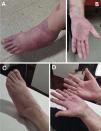
Adalimumab (Hyrimoz®) was then started, resulting in a highly favorable response. However, three months after initiating Hyrimoz®, the patient's health insurance replaced it with another adalimumab biosimilar, Amgevita®. Two months later, she developed new psoriasiform lesions on her hands and feet, along with recurrence of joint swelling and pain (Fig. 1A and B).

Fig. 1.

Skin lesions after the first switch to a biosimilar and the subsequently improvement after reintroduction of the first one. (A, B) Lesions post-Amgevita®. (C, D) Improvement of the skin lesions after Hyrimoz® reintroduction.

Given the appearance of new and severe skin lesions and worsening joint symptoms, two clinical questions emerged: Was this a paradoxical reaction to the anti-TNF agent, suggesting a need to switch therapeutic class? Or could reintroduction of the previously effective biosimilar be considered? Treatment with Hyrimoz® was resumed, leading to marked and sustained improvement after three months (Fig. 1C and D).

Psoriasis is a chronic, immune-mediated skin disorder affecting 2–3% of the global population.1 Anti-TNF agents have revolutionized the management of inflammatory diseases. However, they are associated with paradoxical reactions.2–5 Paradoxical adverse events can occur with both biologics and biosimilars.6 These reactions involve the unexpected onset or worsening of an immune-mediated condition typically treated by the same drug. While they often improve after discontinuing or switching the biologic, some cases may reflect a class effect, requiring complete withdrawal of anti-TNF therapy.7,8

In this case, the recurrence of symptoms appears to have been related specifically to the biosimilar switch rather than a class effect. Reintroduction of the original biosimilar (Hyrimoz®) led to a favorable clinical response, highlighting the importance of individualized evaluation when managing treatment with biosimilars.


References
[1]
R. Parisi, I.Y.K. Iskandar, E. Kontopantelis, M. Augustin, C.E.M. Griffiths, D.M. Ashcroft.
Global psoriasis atlas. National, regional, and worldwide epidemiology of psoriasis: systematic analysis and modelling study.
BMJ, 369 (2020), pp. m1590
[2]
D. Wendling, C. Prati.
Paradoxical effects of anti-TNF-α agents in inflammatory diseases.
Expert Rev Clin Immunol, 10 (2014), pp. 159-169
[3]
L. Puig, W. Gulliver.
Adverse reactions to biologics.
pp. 49-63
[4]
P. Gisondi, F. Bellinato, G. Girolomoni.
The risk of paradoxical psoriasis in patients with inflammatory bowel disease treated with anti-TNF-α agents: a systematic review and meta-analysis.
J Crohns Colitis, 15 (2021), pp. 1266-1274
[5]
A.W. Armstrong, A.M. Soliman, K.A. Betts, Y. Wang, Y. Gao, L. Puig, et al.
Comparative efficacy and relative ranking of biologics and oral therapies for moderate-to-severe plaque psoriasis: a network meta-analysis.
Dermatol Ther (Heidelb), 11 (2021), pp. 885-905
[6]
A.N. Collamer, D.F. Battafarano.
Psoriatic skin lesions induced by tumor necrosis factor antagonist therapy: clinical features and possible immunopathogenesis.
Semin Arthritis Rheum, 40 (2010), pp. 233-240
[7]
M. Munera-Campos, F. Ballesca, J.M. Carrascosa.
Paradoxical reactions to biologic therapy in psoriasis: a review of the literature.
Actas Dermosifiliogr (Engl Ed), 109 (2018), pp. 791-800
[8]
É. Toussirot, F. Aubin.
Paradoxical reactions under TNF-α blocking agents and other biological agents given for chronic immune-mediated diseases: an analytical and comprehensive overview.
RMD Open, 2 (2016), pp. e000239

Statement of equal contribution: Author 1, 2 and 3 contributed equally to this study.

Copyright © 2025. Sociedad Española de Reumatología (SER), Colegio Mexicano de Reumatología (CMR) and Elsevier España, S.L.U.
Download PDF
Idiomas
Reumatología Clínica (English Edition)
Article options
Tools