


Urate is the final product of purine catabolism, and its levels have been linked to various cardiometabolic disorders. In Mexico, most epidemiological data on urate levels derive from populations with existing comorbidities, limiting the establishment of normative reference values.
ObjectiveTo characterize the distribution of serum urate concentrations in a healthy adult population residing in Mexico City.
MethodsA cross-sectional analysis was conducted using data from 3099 healthy adults (64.6% women) enrolled in the Tlalpan 2020 cohort. Participants with chronic diseases, abnormal blood pressure or glucose levels, or exposure to urate-altering medications were excluded. Clinical, anthropometric, and biochemical parameters were recorded, and serum urate concentrations were analyzed overall and stratified by sex.
ResultsThe median serum urate level in the overall cohort was 5.16mg/dL (interquartile range, 4.32–6.15), with a central 95% reference interval ranging from 3.05 to 7.98mg/dL. Median urate levels differed significantly by sex: 4.60mg/dL (3.99–5.28) in women and 6.39mg/dL (5.61–7.09) in men. The prevalence of hyperuricemia in the total cohort was 16.5%, notably higher in men (28.4%) compared to women (10.0%).
ConclusionThis study establishes sex-specific reference values for serum urate in a healthy Mexican adult population. The findings may inform clinical decision-making and future research on urate-related risk stratification.
El urato es el producto final del catabolismo de las purinas y su concentración se ha asociado con diversos trastornos cardiometabólicos. En México, la mayoría de los datos epidemiológicos sobre los niveles de urato provienen de poblaciones con comorbilidades existentes, lo que limita el establecimiento de valores de referencia normativos.
ObjetivoCaracterizar la distribución de las concentraciones séricas de urato en una población adulta sana residente en la Ciudad de México.
MétodosSe realizó un análisis transversal utilizando datos de 3,099 adultos sanos (64.6% mujeres) incluidos en la cohorte Tlalpan 2020. Se excluyeron participantes con enfermedades crónicas, cifras anormales de presión arterial o glucosa, o exposición a medicamentos que alteran el urato. Se registraron parámetros clínicos, antropométricos y bioquímicos, y las concentraciones de urato se analizaron de forma global y estratificadas por sexo.
ResultadosLa mediana de urato sérico en la cohorte fue de 5.16mg/dL (rango intercuartílico: 4.32–6.15), con un intervalo de referencia (95%) que oscila entre 3.05 y 7.98mg/dL. Las concentraciones de urato difirieron significativamente por sexo: 4.60mg/dL (3.99–5.28) en mujeres y 6.39mg/dL (5.61–7.09) en hombres. La prevalencia de hiperuricemia en la cohorte total fue de 16.5%, siendo mayor en hombres (28.4%) que en mujeres (10.0%).
ConclusiónEste estudio establece valores de referencia de urato específicos por sexo en una población mexicana adulta sana. Los hallazgos pueden ser útiles para la toma de decisiones y para futuras investigaciones sobre la estratificación del riesgo relacionado con el urato.
Urate is the end product of purine nucleotide catabolism and is primarily excreted through renal clearance, with a smaller proportion eliminated via the gastrointestinal tract. Despite these dual elimination pathways, the highly efficient tubular reabsorption of urate results in only 10–15% of the filtered urate load ultimately being excreted.1,2 Hyperuricemia, defined as serum urate concentrations exceeding 7mg/dL in men and 6mg/dL in women,3 is a well-established risk factor for a broad spectrum of pathological conditions, including cardiovascular disease, acute and chronic kidney disease, pulmonary hypertension, and gout.4
The etiology of hyperuricemia involves increased endogenous production of urate, reduced renal excretion, dietary influences, gut microbiota dysbiosis, or a combination of these factors.5,6 Clinically, hyperuricemia may be asymptomatic or symptomatic, with vascular, renal, and articular complications being the most frequently reported manifestations.7 Beyond its classical association with gout, elevated urate levels have increasingly been implicated in the development of metabolic disorders and are considered an emerging biomarker for cardiovascular morbidity and mortality.4,8
Epidemiological estimates indicate that approximately 15% of the adult population in Mexico is affected by hyperuricemia, equating to nearly 10 million individuals.9 Alarmingly, its prevalence among younger age groups has reached 24.6%, underscoring the early onset of this metabolic abnormality and highlighting the urgent need for early risk stratification and preventive public health strategies.10
Despite the growing clinical and public health relevance of hyperuricemia, there is a striking lack of recent population-based studies evaluating serum urate levels in healthy individuals in Mexico. Most existing data are derived from cohorts with established chronic diseases, such as diabetes or hypertension, which limits the ability to define reference ranges applicable to primary prevention.11 Moreover, large-scale national databases such as the National Survey of Health and Nutrition 2016 (ENSANUT 2016) do not differentiate between Mexico City and other regions, thereby obscuring potential geographic and demographic variability.12
Mexico City, the country's largest and most densely populated urban center, presents a unique epidemiological landscape characterized by high rates of sugar-sweetened beverage consumption, purine-rich dietary patterns, sedentary lifestyles, and air pollution, all of which may contribute to elevated urate levels.13 Additionally, cardiovascular disease remains the leading cause of death in this region.14 These contextual factors underscore the importance of establishing robust, region-specific biomarker profiles that can inform early intervention strategies.
Identifying early indicators of cardiometabolic risk, such as serum urate levels, in asymptomatic individuals is essential for the development of evidence-based preventive measures. However, the absence of normative data in young, healthy populations remains a significant limitation. Addressing this gap is crucial to improving risk prediction, guiding public health interventions, and ultimately reducing the burden of hyperuricemia-related complications. Therefore, the primary objective of this study was to characterize the distribution of serum urate levels in a healthy population of young and middle-aged adults residing in Mexico City. In addition, we aimed to determine the sex-stratified prevalence of low, normal, and elevated urate levels, thereby contributing to the establishment of reference values for preventive clinical practice.
Materials and methodsStudy designThis study is a descriptive, cross-sectional, post hoc analysis based on anonymized data derived from the Tlalpan 2020 cohort, a prospective, observational study designed to evaluate the impact of traditional and nontraditional risk factors on the development of hypertension. A detailed description of the cohort methodology has been published previously.15 In brief, the cohort enrolled clinically healthy adults aged 20–50 years residing in Mexico City. Exclusion criteria included a prior diagnosis of hypertension, diabetes mellitus, thyroid disease, stroke, acute coronary syndrome, cancer, cardiac or renal failure, or the use of medications known to influence blood pressure or urate levels. Pregnant women were also excluded. Eligible participants were also required to have a blood pressure<140/90mmHg, confirmed by three separate resting measurements, and a fasting plasma glucose level ≤125mg/dL.
At baseline, participants underwent a comprehensive evaluation including sociodemographic profiling, clinical assessment, anthropometric measurements, dietary evaluation, and laboratory testing. Biochemical analyses included fasting glucose, lipid profile, electrolyte panel, urinalysis, and complete blood count. All laboratory tests were performed at the central laboratory of the Instituto Nacional de Cardiología Ignacio Chávez, a tertiary care academic hospital in Mexico City. Participant recruitment occurred between 2014 and 2019, with biennial follow-up visits ongoing.
For this analysis, only participants who completed the baseline visit were included. Variables were extracted based solely on their relevance to the current study. Individuals who did not reside within the administrative boundaries of Mexico City, verified through their official electoral identification, were excluded, as were participants with a self-reported history of gout, autoimmune diseases, chronic inflammatory conditions, or missing serum urate data at enrollment.
Serum urate levels were classified using reference thresholds established by the National Health and Nutrition Examination Survey (NHANES).16 Low urate was defined as <4.0mg/dL in women and <5.0mg/dL in men; normal urate as 4.0 to <6.0mg/dL in women and 5.0 to <7.0mg/dL in men; and elevated urate as ≥6.0mg/dL in women and ≥7.0mg/dL in men.
Ethical considerationsAll participants provided written informed consent before enrollment. The study protocol was approved by the institutional ethics committee (protocol number 13-802) and conducted in accordance with the ethical principles outlined in the Declaration of Helsinki and applicable local regulations.
Statistical analysisThe distribution of continuous variables was assessed using the Shapiro–Wilk, Kolmogorov–Smirnov, and Anderson–Darling tests, all of which indicated non-Gaussian distributions. Consequently, non-parametric statistical methods were applied. Continuous variables were reported as medians with interquartile ranges (IQR) and analyzed using the Mann–Whitney U test. Categorical variables were presented as absolute frequencies and percentages and analyzed using chi square test. Statistical analyses were two-tailed, with a significance threshold set at P<0.05. Calculations were performed using the GraphPad Prism version 10.4.1 (GraphPad Software; La Jolla, CA, USA).
Reference intervals for serum urate levels were established following the Clinical and Laboratory Standards Institute guidelines.17 Outliers were identified and excluded using the IQR method: the 25th percentile (Q1) and 75th percentile (Q3) were used to compute the IQR (Q3−Q1). The lower (Q1−1.5×IQR) and upper (Q3+1.5×IQR) thresholds were then computed, and values outside these limits were classified as outliers and excluded. This outlier removal process was applied iteratively to each sex-stratified subsample to ensure robust estimation of reference intervals.18 The exclusion of outliers aimed to ensure that the derived reference intervals accurately reflected the central tendency of a healthy population, minimizing the influence of extreme or atypical values.
Reference values were calculated by determining the central 95% distribution of the cleaned dataset. The median (50th percentile) served as the central value, while the 2.5th and 97.5th percentiles defined the lower and upper limits of the reference interval, respectively.19 These calculations were performed for the overall study population and stratified by sex.
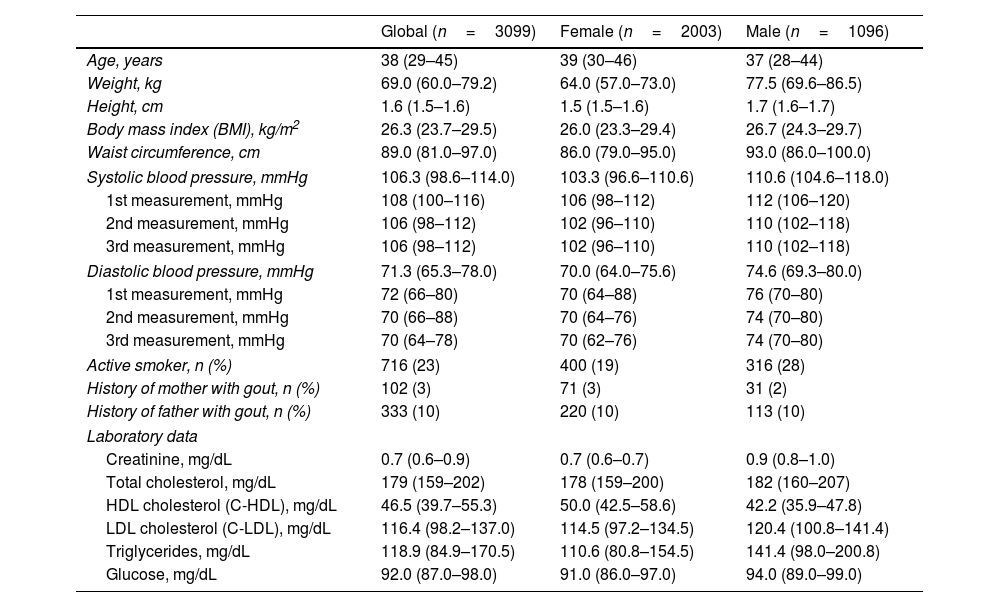
ResultsA total of 3099 clinically healthy individuals were included in the analysis, of whom 2003 (64.6%) were women. The median age of the study population was 38 years (29–45 years). The main clinical and anthropometric characteristics of the cohort are summarized in Table 1, both overall and stratified by sex.
Clinical characteristics of study participants in the Tlalpan 2020 cohort.
| Global (n=3099) | Female (n=2003) | Male (n=1096) | |
|---|---|---|---|
| Age, years | 38 (29–45) | 39 (30–46) | 37 (28–44) |
| Weight, kg | 69.0 (60.0–79.2) | 64.0 (57.0–73.0) | 77.5 (69.6–86.5) |
| Height, cm | 1.6 (1.5–1.6) | 1.5 (1.5–1.6) | 1.7 (1.6–1.7) |
| Body mass index (BMI), kg/m2 | 26.3 (23.7–29.5) | 26.0 (23.3–29.4) | 26.7 (24.3–29.7) |
| Waist circumference, cm | 89.0 (81.0–97.0) | 86.0 (79.0–95.0) | 93.0 (86.0–100.0) |
| Systolic blood pressure, mmHg | 106.3 (98.6–114.0) | 103.3 (96.6–110.6) | 110.6 (104.6–118.0) |
| 1st measurement, mmHg | 108 (100–116) | 106 (98–112) | 112 (106–120) |
| 2nd measurement, mmHg | 106 (98–112) | 102 (96–110) | 110 (102–118) |
| 3rd measurement, mmHg | 106 (98–112) | 102 (96–110) | 110 (102–118) |
| Diastolic blood pressure, mmHg | 71.3 (65.3–78.0) | 70.0 (64.0–75.6) | 74.6 (69.3–80.0) |
| 1st measurement, mmHg | 72 (66–80) | 70 (64–88) | 76 (70–80) |
| 2nd measurement, mmHg | 70 (66–88) | 70 (64–76) | 74 (70–80) |
| 3rd measurement, mmHg | 70 (64–78) | 70 (62–76) | 74 (70–80) |
| Active smoker, n (%) | 716 (23) | 400 (19) | 316 (28) |
| History of mother with gout, n (%) | 102 (3) | 71 (3) | 31 (2) |
| History of father with gout, n (%) | 333 (10) | 220 (10) | 113 (10) |
| Laboratory data | |||
| Creatinine, mg/dL | 0.7 (0.6–0.9) | 0.7 (0.6–0.7) | 0.9 (0.8–1.0) |
| Total cholesterol, mg/dL | 179 (159–202) | 178 (159–200) | 182 (160–207) |
| HDL cholesterol (C-HDL), mg/dL | 46.5 (39.7–55.3) | 50.0 (42.5–58.6) | 42.2 (35.9–47.8) |
| LDL cholesterol (C-LDL), mg/dL | 116.4 (98.2–137.0) | 114.5 (97.2–134.5) | 120.4 (100.8–141.4) |
| Triglycerides, mg/dL | 118.9 (84.9–170.5) | 110.6 (80.8–154.5) | 141.4 (98.0–200.8) |
| Glucose, mg/dL | 92.0 (87.0–98.0) | 91.0 (86.0–97.0) | 94.0 (89.0–99.0) |
Data are presented as median (interquartile range; 25th percentile–75th percentile), unless otherwise specified.
Overall, the study population was overweight, with a median body mass index of 26.3kg/m2 (23.7–29.5). Systolic and diastolic blood pressure readings tended to decrease slightly across the three consecutive measurements, with the first reading being consistently higher than the second and third. A maternal history of gout was present in 3% of participants, while 10% reported a paternal history.
As per the study's eligibility criteria, all participants had fasting glucose and blood pressure values within the normal range (Table 1). Median triglyceride levels were within the normal limits (118.9mg/dL, 84.9–170.5), though they were significantly higher in men than in women (141.4mg/dL, 98.0–200.8 vs. 110.6mg/dL, 80.8–154.5; P<0.001). In contrast, total cholesterol levels were elevated across the cohort (179mg/dL, 159–202), with higher levels observed in men than in women (182mg/dL vs. 178mg/dL; P=0.010). Overall, low-density lipoprotein (LDL) cholesterol levels were also elevated (116.4mg/dL, 98.2–137.0), while high-density lipoprotein (HDL) cholesterol levels were relatively low (46.5mg/dL, 39.7–55.3).
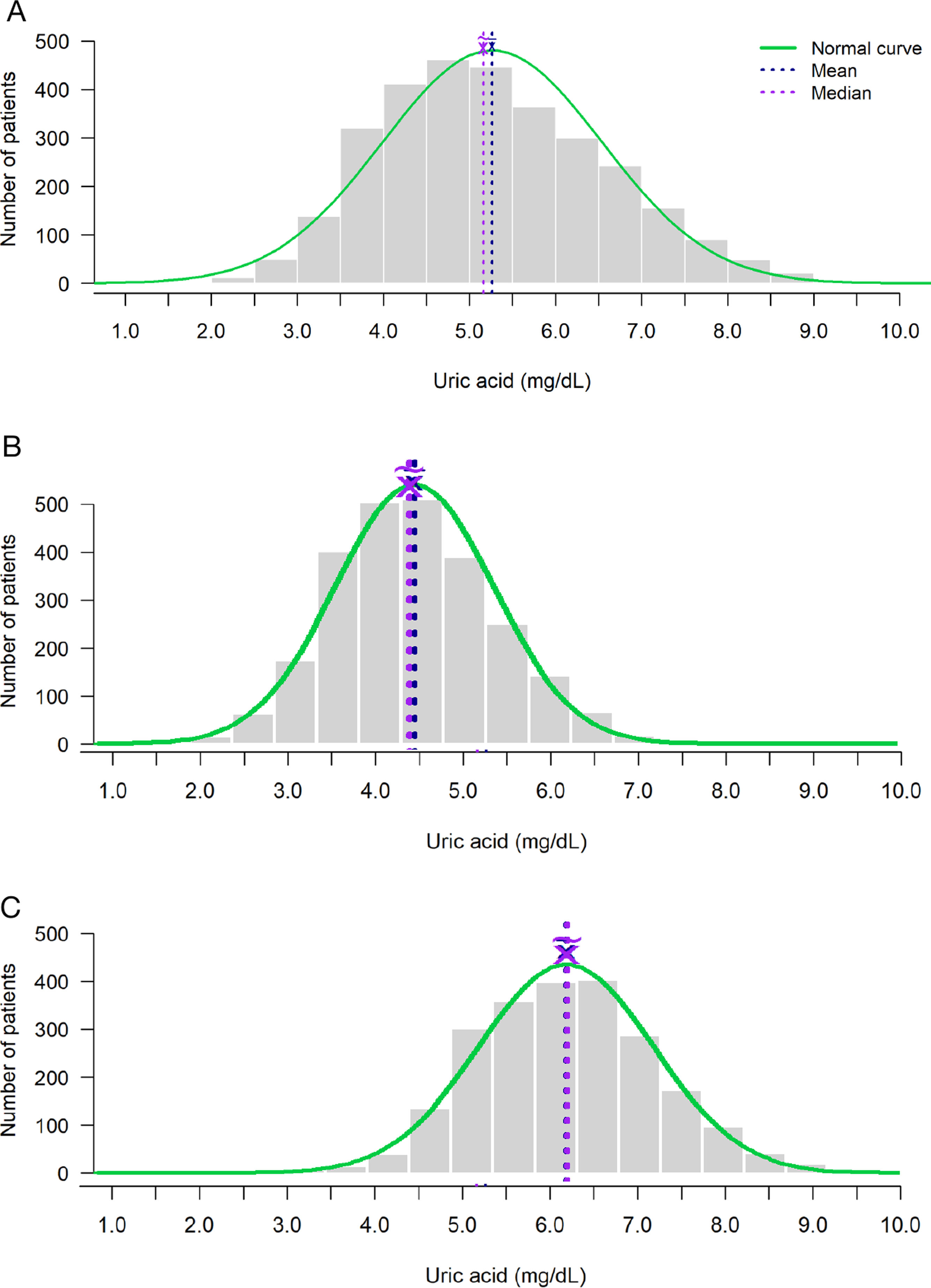
Reference values for serum urate levels are detailed in Table 2. After excluding outliers, the final analytical sample comprised 3071 individuals. Additionally, the population distribution of urate levels is illustrated in Fig. 1. The overall median urate concentration was 5.16mg/dL (4.32–6.15), with the central 95% of values ranging from 3.05 to 7.98mg/dL (Fig. 1A). Statistically significant sex-based differences were observed (P<0.001). Women (n=1978; Fig. 1B) exhibited substantially lower urate levels compared to men (n=1082; Fig. 1C). The median urate level among women was 4.60mg/dL (3.99–5.28), whereas among men it was 6.39mg/dL (5.61–7.09).
Distribution of serum urate levels. Panel A illustrates the distribution of serum urate levels across the entire study cohort, while Panels B and C show the distributions stratified by sex (women and men, respectively). Gray bars represent the number of individuals within each urate stratum. The green line indicates the distribution curve. The purple vertical dotted line marks the median urate level, and the blue vertical dotted line denotes the mean.
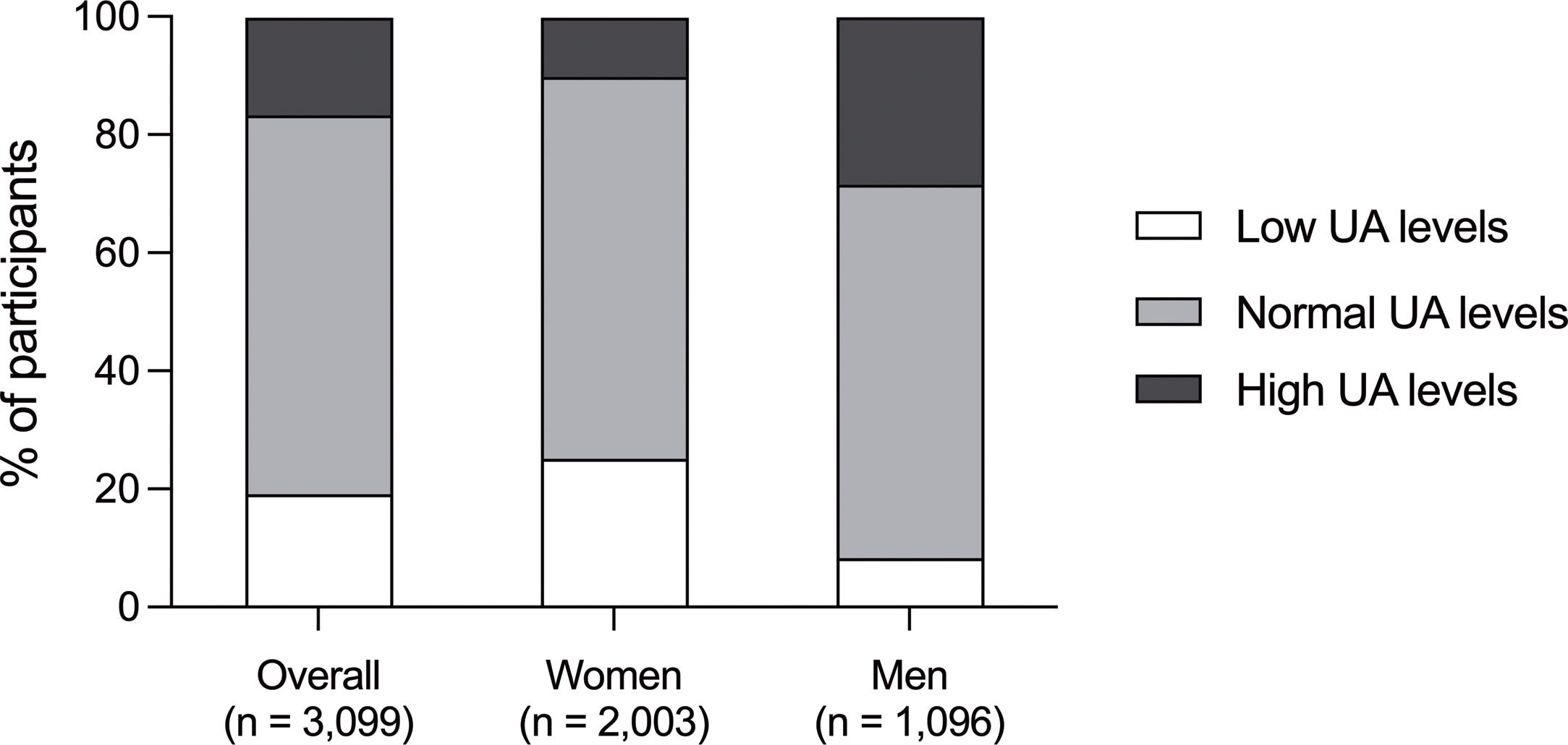
The distribution of urate categories revealed distinct sex-specific patterns (P<0.001; Fig. 2). Low urate concentrations were more prevalent among women (25.1%) than among men (8.3%). Normouricemia was observed at similar frequencies in both sexes (64.7% in women vs. 63.2% in men). In contrast, hyperuricemia was significantly more common in men (28.4%) than in women (10.0%). In the total cohort, the overall prevalence of hypouricemia, normouricemia, and hyperuricemia was 19.1%, 64.2%, and 16.5%, respectively.
Categorization of study participants based on serum urate concentrations. Participants were classified according to their serum urate levels as having hypouricemia (<4.0mg/dL in women and <5.0mg/dL in men; white bars), normouricemia (4.0 to <6.0mg/dL in women and 5.0 to <7.0mg/dL in men; gray bars), or hyperuricemia (≥6.0mg/dL in women and ≥7.0mg/dL in men; black bars). In addition to the overall high prevalence of hyperuricemia in the study cohort (16.5%), the distribution exhibited clear sex-specific differences, with hyperuricemia being significantly more common in men than in women (28.4% vs. 10.0%; P<0.001). UA denotes urate.
This study aimed to characterize the distribution of serum urate levels in clinically healthy adults residing in Mexico City. The overall median urate concentration was 5.16mg/dL (4.32–6.15), with a hyperuricemia prevalence of 16.5%. Notably, elevated urate levels were more frequent among men (28.4%) than women (10.0%).
There is increasing recognition of elevated urate as a contributor to the pathogenesis of a range of diseases, including hypertension, chronic kidney disease, and cardiometabolic disorders.4 Longitudinal studies have demonstrated that elevated urate may precede the onset of hypertension and is independently associated with albuminuria in hypertensive individuals.20,21 Elevated urate has also been implicated in progressive reductions in glomerular filtration rate and overall renal function.22 Its role in metabolic syndrome has also been well documented, with reports indicating a 67% higher incidence among individuals with elevated urate levels, an effect particularly marked in women.23 In patients with ST-segment elevation myocardial infarction, hyperuricemia at admission is associated with a doubling of the risk of short-term mortality compared to their normouricemic counterparts.8 In obstetric populations, first-trimester hyperuricemia has been linked to subsequent preeclampsia, and urate measurement after 20 weeks of gestation has been shown to have diagnostic and prognostic value in gestational hypertension.24,25
In Mexico, most available epidemiological data on urate have focused on populations with established cardiometabolic conditions, thereby limiting their utility in defining physiological reference ranges. For instance, the Mexico City Diabetes Study reported high mean urate levels (8.1±0.9mg/dL in men and 7.1±1.1mg/dL in women) and a hyperuricemia prevalence of 26.5% and 19.8% in men and women, respectively. However, these findings primarily reflect individuals already affected by cardiovascular risk factors, diminishing their relevance for preventive care settings.26 Similarly, although the ENSANUT 2016 provided national-level estimates (mean urate of 5.1mg/dL in men, 4.2mg/dL in women), these were derived from heterogeneous populations that included individuals with chronic non-communicable diseases,12 limiting their value for establishing normative ranges in healthy adults. By contrast, a key strength of the present study lies in its deliberate exclusion of individuals with non-communicable conditions or exposure to medications known to influence urate metabolism. This methodological approach allowed for a more accurate characterization of the physiological distribution of serum urate levels. Moreover, the age profile of the study cohort, comprising young and middle-aged adults, aligns with a demographically significant segment of the Mexican population, enhancing the generalizability and public health relevance of the findings.
Our group has previously built upon data from the Tlalpan 2020 cohort to explore the multifactorial regulation of urate using machine learning approaches.27 These analyses identified serum creatinine, triglyceride levels, urinary sodium excretion, and BMI as key clinical predictors of urate concentrations. Behavioral and hereditary contributors, such as smoking status (active and passive), alcohol intake, sleep quality, and parental history of diabetes or gout, were also independently associated with urate levels. Notably, dietary patterns played a sex-specific role. Among men, frequent consumption of sugar-sweetened beverages, fructose-rich products, processed meats, and certain oils was associated with higher urate levels, while in women, urate concentrations were more closely linked to alcohol and refined carbohydrate intake, as well as fasting glucose levels.27 The present findings support the role of elevated serum urate as both an independent and interactive risk factor for hypertension, endothelial dysfunction, and cardiovascular disease, particularly in men. Mechanistically, estrogens have been shown to inhibit xanthine oxidase activity (a major source of urate and reactive oxygen species), enhance renal urate excretion via upregulation of transporters such as URAT1, and preserve endothelial function. Consistent with this, menopause is associated with increased serum urate levels and a heightened risk of cardiovascular disease.28 Conversely, testosterone may promote urate production and reduce renal urate clearance, thereby contributing to increased cardiovascular risk in men. Urate, even at physiological concentrations, has been shown to alter the proliferation and migration of vascular endothelial cells, and to impair nitric oxide availability through the expression of C-reactive protein.29 Collectively, these findings underscore the complex interplay of genetic, metabolic, lifestyle, and nutritional factors in shaping urate profiles, even among ostensibly healthy individuals.27
Several methodological strengths support the validity of our findings. First, the large sample size enhances statistical power and generalizability. Second, the inclusion of only healthy participants without chronic disease reduces confounding and allows for a clearer understanding of urate distribution. Third, all biochemical analyses were performed in a centralized laboratory, minimizing inter-laboratory variability. Finally, the geographical setting of the study (Mexico City) provides an epidemiologically relevant urban context. As the most densely populated metropolitan area in the country, with a high prevalence of urate-associated risk factors, and a concentrated network of tertiary healthcare services like the National Institutes of Health, this setting enhances the relevance of the data for public health planning in urban environments.
Nonetheless, the study has limitations. Its cross-sectional design prevents causal inference regarding the relationship between urate levels and cardiometabolic outcomes. It remains uncertain whether hyperuricemia in this population is a precursor to metabolic disturbances or a marker of underlying subclinical dysfunction. Additionally, as the study was restricted to a single urban region, the results may not be generalizable to rural populations or other areas of Mexico with differing environmental exposures, dietary habits, or genetic backgrounds. This geographical limitation may also contribute to an over- or underestimation of hyperuricemia prevalence relative to national averages.
In conclusion, this study provides a detailed characterization of serum urate levels in a healthy urban Mexican population, establishing updated reference values and highlighting important sex-based differences. These findings offer a critical foundation for future epidemiological, clinical, and preventive strategies aimed at understanding and mitigating urate-related cardiometabolic health risks in the Mexican population.
Ethical disclosuresAll participants provided written informed consent before enrollment. The study protocol was approved by the institutional ethics committee (protocol number 13-802) and conducted in accordance with the ethical principles outlined in the Declaration of Helsinki and applicable local regulations.
Generative AIThe authors declare that they have not used any type of generative artificial intelligence for the writing of this manuscript, nor for the creation of table captions and/or figure legends.
FundingThis research did not receive any specific grant from funding agencies in the public, commercial, or not-for-profit sectors.
Conflict of interestsAll the authors declare no conflicts of interest.
None to be acknowledged.