


Suggestions
Idioma
Guide for authors
Searcher
Journal Information
Visits
728
Vol. 21. Issue 8.
(October 2025)
Original article
Full text access

Spanish cross-cultural adaptation and psychometric validation of the graded chronic pain scale revised for fibromyalgia

Adaptación transcultural española y validación psicométrica de la Escala Graduada de Dolor Crónico Revisada para fibromialgia
Visits
728
José Édgar Ferrández-Gómeza,b, Mariano Gacto-Sánchezc,
Corresponding author
marianogacto@um.es

Corresponding author.
, Aitor Baño-Alcarazc
a Physiotherapy Area, Pathology and Surgery Department, School of Medicine, University of Miguel Hernández de Elche, Ctra, Nacional N-332 s/n, 03550 San Juan de Alicante, Spain
b Faculty of Physiotherapy, Occupational Therapy and Podiatry, UCAM Catholic University of Murcia, Murcia, Spain
c Department of Physical Therapy, Campus of Health Sciences, University of Murcia, Av. Buenavista, 32, 30120 El Palmar, Murcia, Spain
This item has received
Article information
Abstract
Full Text
Bibliography
Download PDF
Statistics
Figures (1)
fig0005
Tables (3)
Table 1. Final version of the GCPS-R-SP.
Tables
Table 2. Sociodemographic and clinical characteristics of the sample (n=224, unless otherwise stated).
Tables
Table 3. Items and factor loadings from the GCPS-R-SP.
Tables
Abstract
Background

Chronic widespread pain represents one of the cornerstones in the definition of fibromyalgia. Pain severity can be measured through different instruments, among which the Graded Chronic Pain Scale represents an outstanding framework to assess pain. Its revised version (GCPS-R) has been recently created to adhere to the new paradigmatic definition of chronic pain. Despite the relevance and clinical impact of the GCPS-R, its validation into Spanish has not been performed yet.

Objectives

To develop a cross-cultural Spanish-language adaptation of the GCPS-R in a sample of patients diagnosed with fibromyalgia. Besides, we aimed to carry out an initial psychometric analysis of the questionnaire in this population.

Methods

An observational, prospective, longitudinal study was conducted among a sample of subjects with fibromyalgia. The translation and cross-cultural adaptation of the GCPS-R was performed, and the new version of the instrument was administered to patients with fibromyalgia. Construct validity was assessed by means of factor analysis, whilst internal consistency, convergent validity, and test–retest reliability were also performed.

Results

The sample analyzed consisted of 224 subjects overall. Factor 1 displayed a Cronbach's alpha of 0.711, whilst Factor 2 had an alpha value of 0.890. The convergent validity analysis performed on the pain-intensity subscale of the instrument yielded statistically significant and strong correlation coefficients (Pearson's r=0.713; p-value<0.001). Test–retest reliability yielded weighted Cohen's Kappa scores of 0.537 (p-value<0.001).

Conclusion

The GCPS-R-SP represents a simple, easy to administrate, and clinically efficient measure with favorable psychometric properties, covering the level and the impact of chronic pain in subjects with fibromyalgia.

Keywords:
Fibromyalgia
Chronic pain
Assessment
Validation
Clinimetrics
Psychometric properties
Resumen
Introducción

El dolor crónico generalizado representa una de las piedras angulares en la definición de fibromialgia. La gravedad del dolor se puede medir mediante diferentes instrumentos, entre los cuales la Escala Graduada de Dolor Crónico representa un marco sobresaliente para evaluar el dolor. Su versión revisada (GCPS-R) ha sido creada recientemente para adherirse a la nueva definición paradigmática de dolor crónico. A pesar de la relevancia e impacto clínico del GCPS-R, aún no se ha realizado su validación al español.

Objetivos

Desarrollar una adaptación transcultural al idioma español del GCPS-R en una muestra de pacientes diagnosticados con fibromialgia. Además, nos propusimos realizar un análisis psicométrico inicial del cuestionario en esta población.

Métodos

Se realizó un estudio observacional, prospectivo y longitudinal entre una muestra de sujetos con fibromialgia. Se realizó la traducción y adaptación transcultural del GCPS-R y se administró la nueva versión del instrumento a pacientes con fibromialgia. La validez de constructo se evaluó mediante análisis factorial, además de la consistencia interna, la validez convergente y la fiabilidad test-retest.

Resultados

La muestra analizada estuvo compuesta por 224 sujetos en total. El factor 1 mostró un alfa de Cronbach de 0,711, mientras que el factor 2 tuvo un valor alfa de 0,890. La validez convergente del instrumento, testada sobre la subescala de intensidad álgica, mostró correlación fuerte y estadísticamente significativa (r Pearson=0.713; p-valor<0.001). La fiabilidad test-retest resultó en puntuaciones Kappa ordinal de Cohen de 0.537 (p-valor<0.001).

Conclusión

El instrumento GCPS-R-SP representa una medida simple, fácil de administrar y clínicamente eficiente con propiedades psicométricas favorables, que cubre el nivel y el impacto del dolor crónico en sujetos con fibromialgia.

Palabras clave:
Fibromialgia
Dolor crónico
Evaluación
Validación
Clinimetría
Propiedades psicométricas
Full Text
Background

In terms of years lived with disability, chronic pain represents the main source of worldwide disability nowadays.1 Chronic widespread pain represents one of the cornerstones in the definition of fibromyalgia (FM), and the recently revised International Classification of Diseases in its 11th revision classifies fibromyalgia as a form of chronic widespread pain.2 With a worldwide prevalence of 2.7%, FM affects mainly women in a 50–60 years range, and it represents a relevant burden at multiple levels, given the impact on the economic, living habits and daily routine spheres.3

In order to measure pain severity, several specific instruments in the framework of chronic pain exist. The Graded Chronic Pain Scale (GCPS) was initially developed as a brief tool to measure pain severity,4 and it has been validated into Spanish in subjects with low-back pain.5 More recently, the instrument has been revised and updated to adhere to the new paradigmatic definition of chronic pain,6 delving into the Graded Chronic Pain Scale-Revised (GCPS-R), which measures the impact of chronic pain. It is based on six simple items on pain in general, through an algorithm that classifies chronic pain into four different categories: absent, mild, bothersome, and high-impact chronic pain. The first two questions of the GCPS-R enquire about the level of pain and limitation in the past three months. The sum of the third, fourth, and fifth questions correspond to the 3-item ultra-brief pain measure Pain, Enjoyment of Life and General Activity (PEG) Scale7 and represent the total score of the questionnaire. The PEG scale specifically assesses pain intensity and interference.7 Item 6, which is not used to grade chronic pain, is a dichotomous question about the impact of paint on work status, and it does not influence the score of the questionnaire whatsoever. The final score of the GCPS-R is not summative, since it follows a tailored algorithm thoroughly explained in the original version of the instrument.6 Globally, subjects reporting, on item 1, no pain or pain on some days are placed at Grade 0 (which stands for “chronic pain absent”). Subjects with no chronic pain, even though they can report non-chronic pain that may be bothersome or may have a relevant impact, may also be included in Grade 0. As for people reporting the presence of chronic pain, they should be placed at Grades 1, 2 or 3: subjects whose chronic pain is not of high impact and with PEG scores below 12 points are placed at Grade 1 (“mild chronic pain”), whilst Grade 2 (i.e., “bothersome chronic pain”) corresponds to scores of and/or beyond 12 points in the PEG subscale. Grade 3 (“high impact chronic pain”) encompasses subjects reporting that pain limits either their life activities or work sphere on most days or every day in the past 3 months. The GCPS-R has been recently adapted and validated in different populations and conditions.8,9

Despite the relevance and clinical impact of the GCPS-R, its validation into Spanish has not been performed yet. The adaptation of the GCPS-R tool into Spanish would provide the clinical community with a useful, time-efficient and specific instrument to measure chronic pain in clinical routines, more specifically in the field of FM, given the prevalence and the subsequent burden of the condition.

The aim of the present study was, therefore, to develop a cross-cultural Spanish-language adaptation of the GCPS-R in a sample of patients diagnosed with FM. Besides, we aimed to carry out an initial psychometric analysis of the questionnaire in this population.

MethodsParticipants

A validation cross-sectional study was conducted among a sample of subjects with FM. This study was carried out following the principles of the Declaration of Helsinki and obtained approval from the Clinical Research Ethics Committee of the University of Murcia under the code 4747/2023. Participants were consecutively recruited from fibromyalgia patient associations throughout Spain. Then, they were included if they met all the following criteria: (i) subjects over 18 years of age, (ii) ability to read and write in Spanish, (iii) medical diagnosis of FM. Subjects concurrently diagnosed with chronic fatigue syndrome, multiple chemical sensitivity syndrome, or neuropsychiatric pathologies (schizophrenia, bipolarity, or cognitive impairment), as well as those under cancer treatments, were excluded from the study.

ProcedureTranslation and cross-cultural adaptation

The translation and cross-cultural adaptation of the GCPS-R was performed. Authorization was obtained from Professor Michael Von Korff, the author of the GCPS-R, via email. The use of the scale does not require copyright fees and/or payment of royalties. The original questionnaire was initially translated into Spanish following recommended guidelines.10 In summary, the process consisted of forward translation, synthesis, and backward translation by two physiotherapists and a professional translator. Any potential dissension was discussed and reviewed by the aforementioned panel. Once the consensus achieved, the face validity of the tool, defined as the “extent to which a test is subjectively viewed as covering the concept it purports to measure”, was confirmed. The resulting pre-final version was pretested with ten subjects with FM, to assess its understandability, ultimately resulting in a final version named GCPS-R-SP (Spanish Version of the Revised Graded Chronic Pain Scale).

Administration of the GCPS-R-SP

After reading the information sheet and signing the corresponding Informed Consent, patients received, through Google Forms, an initial questionnaire, including sociodemographic variables (age, gender, weight, height, educational level, professional status, physical activity), the questionnaire GCPS-R-SP, the Numeric Rating Scale (NRS),11 and the Spanish version of the Fibromyalgia Impact Questionnaire (FIQ).12 The NRS is a unidimensional measure on pain intensity that has been used in the field of fibromyalgia as a pain-related outcome measure,13 whilst FIQ is used to measure the impact of FM on patient health status and his/her quality of life. It consists of 10 items, with higher scores indicating a higher impact of the condition.12 Data collection encompassed the period January–March 2024.

The GCPS-R-SP was administered at two time-points: the second measure, performed among a subgroup of the initial sample two weeks after the first assessment to prevent carry-over effects, had the aim of obtaining the test–retest reliability of the instrument.

Statistical analysis

Descriptive statistics were used to describe baseline sociodemographic variables.

Construct validity was assessed by means of factor analysis (FA), which is a framework used to reduce a large number of variables into fewer numbers of factors. FA can be either “exploratory” (no number of factors is pre-specified) or “confirmatory” (the number of factors can be predefined). Given that the study by Liang et al.8 had already set two different factors, the Confirmatory Factor Analysis (CFA) approach was adopted. For this purpose, model fit was assessed through the root mean square error of approximation (RMSEA),14 the comparative fit index (CFI),15 and the Tucker-Lewis index (TLI).16 RMSEA scores below 0.08 imply reasonably good fit, whilst values below 0.05 entail good fit. On another note, both the CFI and TLI indices score in a 0–1 range, with higher values indicating better fit.14

Once the factors were defined, the internal consistency of the instrument was assessed by calculating the Cronbach's alpha coefficient for each factor, considering 0.70 as a cutoff point for satisfactory alpha values.17 Also, the McDonald's omega coefficient was calculated for each one of the resulting factors.18

The convergent validity of the instrument, i.e., the extent of agreement between two different measures theoretically measuring the same construct, was explored by assessing the correlation between the PEG subscale (embedded within the GCPS-R-SP and providing a real continuous score) and the NRS, since both capture the intensity of pain, by means of Pearson's correlations. The results were interpreted according to the correlation interpretation provided elsewhere.19

Reliability of the GCPS-R-SP was assessed through the weighted Cohen's kappa statistic for agreement,20 due to the ordinal nature of the classification system that the GPCS-R-SP provides. Cohen's kappa ranges in a −1-to-+1 interval, with values ≤0 indicating no agreement, 0.01–0.20 as slight, 0.21–0.40 as fair, 0.41–0.60 as moderate, 0.61–0.80 as substantial, and 0.81–1.00 as excellent agreement.21

As for the size of the sample used for the current psychometric validation, the minimum threshold was set at n=90, since it corresponds to the minimal number determined for the examination of factor analysis,22 with a minimum sample size for the calculation of the internal consistency of the factors set at 24 individuals.23 Focusing on the specific test–retest reliability, a subgroup of a minimum of 30 participants has been suggested as sufficient.17

For all the analyses, the strategy of complete case analysis (or available cases) or listwise deletion was adopted. Solely one case with missing values was recorded: the case was therefore omitted, and the remaining data were subsequently analyzed.

All analyses were performed using IBM SPSS Statistics for Windows, version 28.0 (Armonk, NY, USA: IBM Corp; 2021), with a p-level of significance set at p<.05. For the specific calculation of the McDonald's omega coefficient for each factor, the online calculator by Colwell SR (2016)24 was used. The specific CFA approach was conducted by means of the IBM AMOS 26.0 software (Armonk, NY, USA: IBM Corp; 2019).

Results

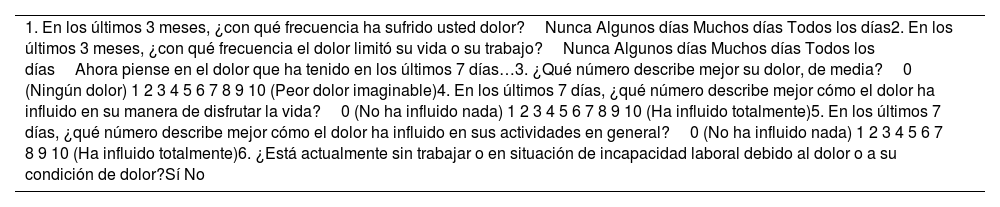
The translation and cross-cultural adaptation of the instrument delved into the final version of the GCPS-R-SP, available in Table 1.

Table 1.

Final version of the GCPS-R-SP.

1. En los últimos 3 meses, ¿con qué frecuencia ha sufrido usted dolor?Nunca Algunos días Muchos días Todos los días2. En los últimos 3 meses, ¿con qué frecuencia el dolor limitó su vida o su trabajo?Nunca Algunos días Muchos días Todos los díasAhora piense en el dolor que ha tenido en los últimos 7 días…3. ¿Qué número describe mejor su dolor, de media?0 (Ningún dolor) 1 2 3 4 5 6 7 8 9 10 (Peor dolor imaginable)4. En los últimos 7 días, ¿qué número describe mejor cómo el dolor ha influido en su manera de disfrutar la vida?0 (No ha influido nada) 1 2 3 4 5 6 7 8 9 10 (Ha influido totalmente)5. En los últimos 7 días, ¿qué número describe mejor cómo el dolor ha influido en sus actividades en general?0 (No ha influido nada) 1 2 3 4 5 6 7 8 9 10 (Ha influido totalmente)6. ¿Está actualmente sin trabajar o en situación de incapacidad laboral debido al dolor o a su condición de dolor?Sí No 

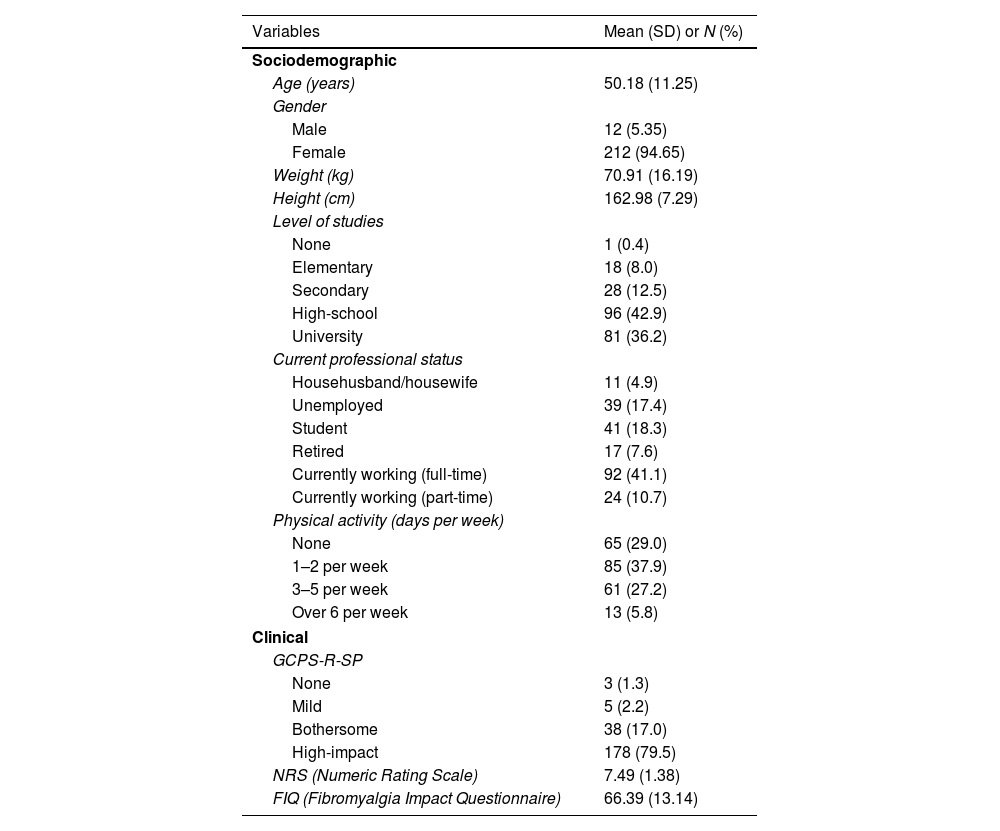
The sample analyzed consisted of 224 subjects overall. A total of 30 different associations from 14 (out of 17) regions in Spain were represented in the sample. Approximately 95% of the sample were women, with mean age of 50.18±11.25 years of age. Most of the sample had either high-school or university studies. Roughly 70% were physically active, and 41.1% were in a full-time job situation. Further data on sociodemographic and clinical data are included in Table 2.

Table 2.

Sociodemographic and clinical characteristics of the sample (n=224, unless otherwise stated).

Variables  Mean (SD) or N (%) 
Sociodemographic
Age (years)  50.18 (11.25) 
Gender
Male  12 (5.35) 
Female  212 (94.65) 
Weight (kg)  70.91 (16.19) 
Height (cm)  162.98 (7.29) 
Level of studies
None  1 (0.4) 
Elementary  18 (8.0) 
Secondary  28 (12.5) 
High-school  96 (42.9) 
University  81 (36.2) 
Current professional status
Househusband/housewife  11 (4.9) 
Unemployed  39 (17.4) 
Student  41 (18.3) 
Retired  17 (7.6) 
Currently working (full-time)  92 (41.1) 
Currently working (part-time)  24 (10.7) 
Physical activity (days per week)
None  65 (29.0) 
1–2 per week  85 (37.9) 
3–5 per week  61 (27.2) 
Over 6 per week  13 (5.8) 
Clinical
GCPS-R-SP
None  3 (1.3) 
Mild  5 (2.2) 
Bothersome  38 (17.0) 
High-impact  178 (79.5) 
NRS (Numeric Rating Scale)  7.49 (1.38) 
FIQ (Fibromyalgia Impact Questionnaire)  66.39 (13.14) 

Concerning the CFA performed, the RMSEA scored 0.041, whilst the values for the CFI and the TLI corresponded to 0.984 and 0.960, respectively. The internal consistency of the two factors generated was subsequently tested: Factor 1 displayed a Cronbach's alpha of 0.711 and a McDonald's omega of 0.761, whilst Factor 2 had an alpha value of 0.890 and a McDonald's omega of 0.907. The results confirm the two-factor structure of the GCPS-R-SP, with Factor 1 including two items and Factor 2 encompassing three items. In fact, the second factor integrally corresponds to the PEG scale. Specific data on factor loadings and factor composition are expounded in Table 3.

Table 3.

Items and factor loadings from the GCPS-R-SP.

Item  Factor  F1  F2 
0.880   
0.679   
  0.813 
  0.899 
  0.908 

For the convergent validity of the instrument, Pearson's correlations performed of the specific second factor of the instrument (i.e., the PEG scale) with the NRS produced strong correlation scores (Pearson's r=0.713; p-value<0.001).

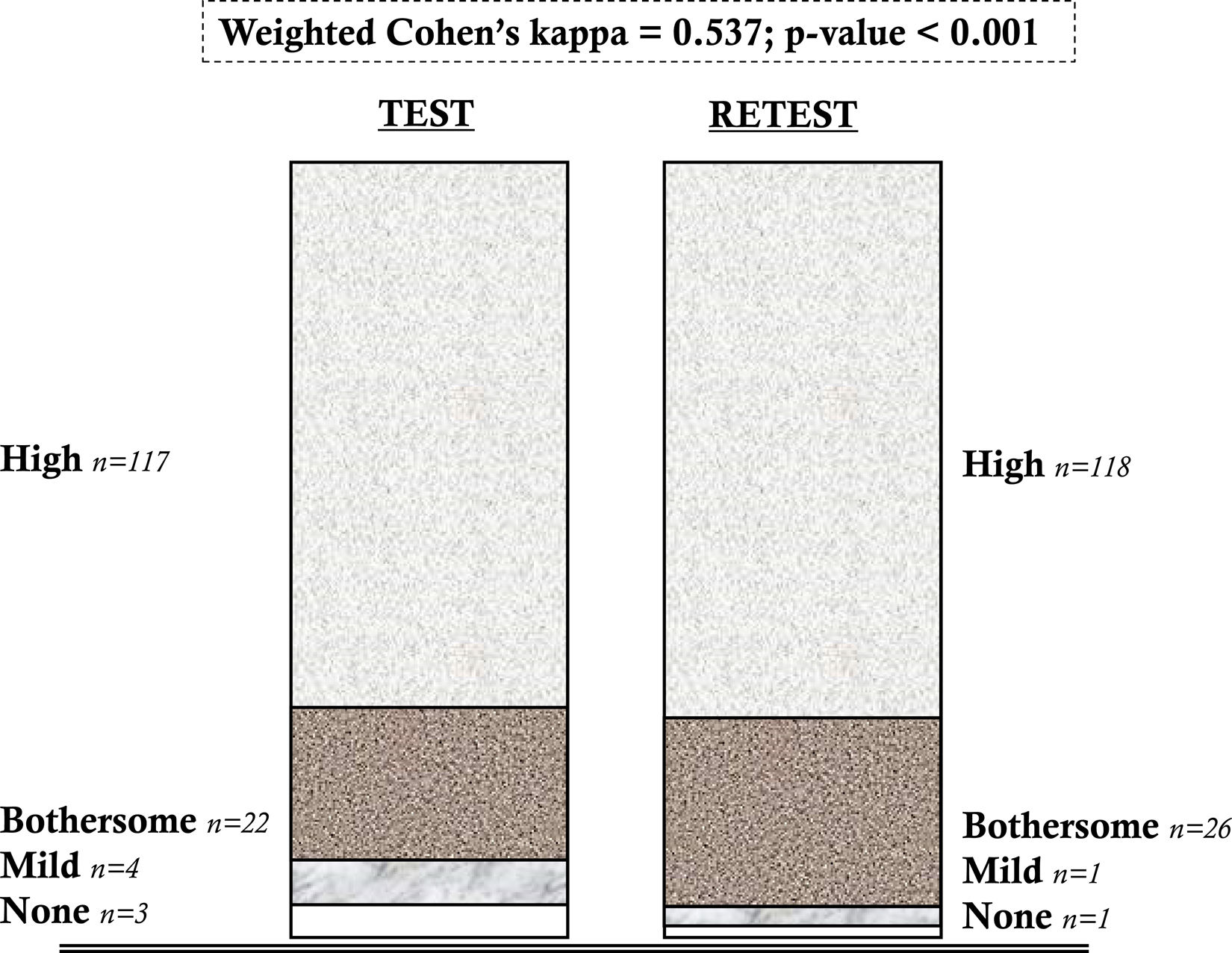
Test–retest reliability was calculated from data stemming from a subgroup of 146 subjects. Weighted Cohen's Kappa corresponded to 0.537 (p-value<0.001) for the global GCPS-R-SP instrument. Fig. 1 displays the graphical representation on the levels of chronic pain in the test and retest period.

Fig. 1.

Test–retest and weighted Cohen's Kappa of the GCPS-R-SP (n=146).

Discussion

To the best of our knowledge, this is the first study to validate and perform an initial psychometric testing of the instrument GCPS-R-SP, a fact that will enable health professionals to apply and assess chronic pain and its impact in clinical routine. The validation has been performed among subjects with fibromyalgia, a widespread and burdensome condition with a complex approach and a recurrent chronic pain assessment, since pain assessment is essential to promote effective care for people with fibromyalgia,25 a fact that highlights the relevance of the study here expounded.

One of the strengths and differential aspects of this article is the validation and subsequent clinical availability of a tool in Spanish for the specific assessment of chronic pain in the field of fibromyalgia. To date, other tools have often been used as “proxies” for measuring chronic pain in FM, such as unidimensional pain intensity tools (NRS) or the FIQ, a specific instrument for measuring the impact of fibromyalgia on functional capacity and quality of life.

The initial psychometric assessment yielded promising results, leading to the general picture of a satisfactory instrument from a statistical perspective, yet some aspects deserve special attention: first, while the scores of the RMSEA, the CFI, and the TLI are adequate and indicate good data-to-model fit,14 the specific analysis of the internal consistency on the first factor yielded a Cronbach's alpha (0.711) evincing a satisfactory level of consistency, yet bordering the cut-off point of 0.70, and lower than that from Liang et al.8 The second factor shows a high level of consistency, and it is, furthermore, an instrument in its own. These differential levels of consistency between both factors could lie on the fact that, as in the original study,6 the first two items were not intended to measure a specific construct, since the first item is used to define whether chronic pain exists, and the second item is used to specifically define limitations due to pain. Both items use a four-category ordinal scale that assesses frequency, which may explain why they are grouped into a single factor.

Moreover, when focusing on the convergent validity of the instrument, the results concerning the pain-intensity subscale of the instrument are statistically significant and they reveal a high extent of correlation with the construct NRS. Further research in this line shall assess other relevant variables (such as pain coping beliefs, psychological distress, health perceptions, or life activity limitations), in order to establish potential hypotheses leading to the evaluation of construct validity through known-groups strategies, since Von Korff et al.6 suggest as a potential further research line the hypothesis that the main differences between subjects with mild and bothersome chronic pain could be predominately characterized by differences in measures of pain coping beliefs, psychological distress and health perceptions, while differences in life activity limitations may ease the identification and differentiation of persons with high impact chronic pain from those with mild chronic pain.

Concerning the test–retest reliability, the results justify the stability of the instrument and its scoring system delving into the ordinal classification of four different levels of chronic-pain, given that the coefficient revealed a moderate to substantial reliability of the two measurements performed. In fact, solely five out of 146 subjects (3.66%) experienced a change in the level of pain impact assigned by the instrument through the algorithm initially provided by the authors.6

The results stemming from our study should be interpreted in the light of its methodological limitations. First, our sample was mainly composed of women: while the figures in our study are somehow consistent with the epidemiologic distribution of the condition – high female predominance, between 80 and 96%,26 the potential exploration of gender-differences in the perception and impact of chronic pain could be of interest within the performance of the instrument, since gender-differences in variables as quality of life have already been stated elsewhere.27 Second, the potential concurrence of other rheumatic diseases (e.g., rheumatoid arthritis, Systemic Lupus Erythematosus, or Sjögren's syndrome) alongside FM was not considered as a potential exclusion criterion, and it could have subsequently limited the pain processing or perception amongst the study subjects. Third, the psychometric properties of the instrument were not tested over time: further studies should explore the sensitivity to change of the measure to assess its performance in capturing true changes through time. Finally, the novelty of the research objective, based on the translation, cultural adaptation and cross-sectional psychometric testing of the instrument specifically in the field of fibromyalgia hinders any potential homogeneity in the comparison with other populations: for instance, the original study by Von Korff et al.6 included subjects with different medical conditions, and with a high percentage of elevated depression/anxiety symptoms, whilst in the study by Liang et al.,8 all subjects stemmed from tertiary care, and a vast majority of the study subjects did not present with chronic conditions. In the present study, by including subjects diagnosed with FM, the fact of recruiting a high percentage of subjects with high-impact chronic pain was foreseeable, and this is confirmed in the characterization of the sample. Further studies should, therefore, focus on the specific field of the outcome-measurement in FM, also psychometrically testing the performance of the instrument over time.

Conclusion

The GCPS-R-SP represents a simple, easy to administrate, and clinically efficient measure with favorable psychometric properties, covering the level and the impact of chronic pain in subjects with FM. The assessment instrument requires little time and resources, a fact that supports and endorses its clinical implementation, since time constraints represent one of the cornerstones of work stress in different professional spheres and healthcare environments.

Credit statement

José Édgar Ferrández-Gómez: Conceptualization, Methodology, Software, Validation, Formal analysis, Investigation, Resources, Data curation, Writing, Visualization and Supervision.

Mariano Gacto-Sánchez: Conceptualization, Methodology, Software, Validation, Formal analysis, Investigation, Resources, Data curation, Writing, Visualization and Supervision.

Aitor Baño-Alcaraz: Conceptualization, Methodology, Software, Validation, Formal analysis, Investigation, Resources, Data curation, Writing, Visualization and Supervision.

Funding

This research did not receive any specific grant from funding agencies in the public, commercial, or not-for-profit sectors.

Conflicts of interest

None.

Acknowledgements

The authors would like to thank the participants of the current study for their involvement, as well as professor Von Korff for his support and generosity.

References
[1]
S.E. Mills, K.P. Nicolson, B.H. Smith.
Chronic pain: a review of its epidemiology and associated factors in population-based studies.
Br J Anaesth, 123 (2019), pp. e273-e283
[2]
World Health Organization.
ICD-11: International classification of diseases (11th revision).
(2022),
[3]
I.C. Álvarez-Gallardo, A. Soriano-Maldonado, V. Segura-Jiménez, F. Estévez-López, D. Camiletti-Moirón, V.A. Aparicio, et al.
High levels of physical fitness are associated with better health-related quality of life in women with fibromyalgia: the al-Ándalus project.
Phys Ther, 99 (2019), pp. 1481-1494
[4]
M. Von Korff, J. Ormel, F.J. Keefe, S.F. Dworkin.
Grading the severity of chronic pain.
[5]
R. Ferrer-Peña, A. Gil-Martínez, J. Pardo-Montero, V. Jiménez-Penick, T. Gallego-Izquierdo, R. La Touche.
Adaptation and validation of the Spanish version of the graded chronic pain scale.
Reumatol Clin, 12 (2016), pp. 130-138
[6]
M. Von Korff, L.L. DeBar, E.E. Krebs, R.D. Kerns, R.A. Deyo, F.J. Keefe.
Graded chronic pain scale revised: mild, bothersome, and high-impact chronic pain.
[7]
E.E. Krebs, K.A. Lorenz, M.J. Bair, T.M. Damush, J. Wu, J.M. Sutherland, et al.
Development and initial validation of the PEG, a three-item scale assessing pain intensity and interference.
J Gen Intern Med, 24 (2009), pp. 733-738
[8]
B. Liang, Y. Wu, J. Zhang, S. Hao, F. Li.
The cross-cultural adaptation and psychometric properties of the Graded Chronic Pain Scale-Revised-Simplified Chinese version.
[9]
C. Taub, K.S. Gordon, J. Goulet, A. Lee, M. Mayhew, M. Von Korff, et al.
Graded chronic pain scale revised: validation in a Veteran sample.
Pain Med, 24 (2023), pp. 1169-1175
[10]
D.E. Beaton, C. Bombardier, F. Guillemin, M.B. Ferraz.
Guidelines for the process of cross-cultural adaptation of self-report measures.
[11]
G.A. Hawker, S. Mian, T. Kendzerska, M. French.
Measures of adult pain: Visual Analog Scale for Pain (VAS Pain), Numeric Rating Scale for Pain (NRS Pain), McGill Pain Questionnaire (MPQ), Short-Form McGill Pain Questionnaire (SF-MPQ), Chronic Pain Grade Scale (CPGS), Short Form-36 Bodily Pain Scale (SF-36 BPS), and Measure of Intermittent and Constant Osteoarthritis Pain (ICOAP).
Arthritis Care Res (Hoboken), 63 (2011), pp. S240-S252
[12]
J. Rivera, T. González.
The fibromyalgia impact questionnaire: a validated Spanish version to assess the health status in women with fibromyalgia.
Clin Exp Rheumatol, 22 (2004), pp. 554-560
[13]
H. Oka, K. Miki, I. Kishita, D.F. Kong, T. Uchida.
A multicenter, prospective, randomized, placebo-controlled, double-blind study of a novel pain management device AT-02, in patients with fibromyalgia.
Pain Med, 21 (2020), pp. 326-332
[14]
H.W. Marsh, K.T. Hau, Z. Wen.
In search of golden rules: comment on hypothesis-testing approaches to setting cutoff values for fit indexes and dangers in overgeneralizing Hu and Bentler's (1999) findings.
Struct Eq Model Multidiscipl J, 11 (2004), pp. 320-341
[15]
P. Bentler.
Comparative fit indices in structural models.
Psychol Bull, 107 (1990), pp. 238-246
[16]
L. Tucker, C. Lewis.
A reliability coefficient for maximum likelihood factor analysis.
Psychometrika, 38 (1973), pp. 1-10
[17]
L.B. Mokkink, E.B.M. Elsman, C.B. Terwee.
COSMIN guideline for systematic reviews of patient-reported outcome measures version 2.0.
Qual Life Res, 33 (2024), pp. 2929-2939
[18]
C.P. Malkewitz, P. Schwall, C. Meesters, J. Hardt.
Estimating reliability: a comparison of Cronbach's α, McDonald's ωt and the greatest lower bound.
[19]
H. Akoglu.
User's guide to correlation coefficients.
Turk J Emerg Med, 18 (2018), pp. 91-93
[20]
A. De Raadt, M.J. Warrens, R.J. Bosker, et al.
A comparison of reliability coefficients for ordinal rating scales.
J Classif, 38 (2021), pp. 519-543
[21]
D.G. Altman.
Practical statistics for medical research.
Chapman & Hall/CRC Press, (1999),
[22]
D.J. Mundfrom, D.G. Shaw, T.L. Ke.
Minimum sample size recommendations for conducting factor analyses.
Int J Test, 5 (2005), pp. 159-168
[23]
M.A. Bujang, E.D. Omar, N.A. Baharum.
A review on sample size determination for Cronbach's alpha test: a simple guide for researchers.
Malays J Med Sci, 25 (2018), pp. 85-99
[24]
S.R. Colwell.
The Composite Reliability Calculator User's Guide. Technical Report.
(2016),
[25]
C.M. De Oliveira, H. Pereira de Souza, K.C.A. Fonseca-Lana, S. Silqueira de Matos, D.M.P. Campos, A.D. de Souza.
Pain evaluation in patients with fibromyalgia: integrative review.
Rev Med Minas Gerais, 33 (2023),
[26]
I. Ruschak, P. Montesó-Curto, L. Rosselló, C. Aguilar Martín, L. Sánchez-Montesó, L. Toussaint.
Fibromyalgia syndrome pain in men and women: a scoping review.
Healthcare (Basel), 11 (2023), pp. 223
[27]
T. Rustøen, A.K. Wahl, B.R. Hanestad, A. Lerdal, S. Paul, C. Miaskowski.
Gender differences in chronic pain – findings from a population-based study of Norwegian adults.
Pain Manag Nurs, 5 (2004), pp. 105-117
Copyright © 2025. Sociedad Española de Reumatología (SER), Colegio Mexicano de Reumatología (CMR) and Elsevier España, S.L.U.
Download PDF
Idiomas
Reumatología Clínica (English Edition)
Article options
Tools